Home » Posts tagged 'evolution' (Page 4)
Tag Archives: evolution
“The Groaning of Creation” – Preface – Chapter 1-1.5
We will begin a new semester this year as we focus on topics in theology and science. This time, we will cover Christopher Southgate’s The Groaning of Creation: God, Evolution, and the Problem of Evil.
Masterclass in Neurotheology
NEUROTHEOLOGY Masterclass
hosted by the Center for Interdisciplinary Research (www.thecir.info)
Sept. 10 – Dec. 10, 2016
This advanced interdisciplinary course meets for eight 3-hour Saturday morning sessions over a 3-month period.
No background in theology or science is required, but a commitment to reading the notes, which are drawn from Ron Choong’s PhD dissertation, is expected.
This inaugural CIR Master-Class will feature Ron Choong’s doctoral work submitted as an interdisciplinary PhD dissertation in 2009 to Princeton Seminary.
Chapter 24: Not Peace but a Sword (1913-60) – Part II

Adolf Hitler greeting Catholic leaders during a Nazi rally.
We will finish up the rest of Chapter 24 and discuss the impact World War II had upon Christendom.
Please read the last three sections: The Churches and Nazism: The Second World War, World Christianity Realigned: Ecumenical Beginnings, and World Christianity Realigned: Pentecostals and New Churches.
A Reply from one of our members about the 11/13 post.
Chris wanted to clarify his position on the post i made here about the conversation we had during our last meeting last month that concerned evolution – human evolution in particular.
Here is his statement:
“Perhaps I was unclear in my comments. I apologize.
With respect to whether God directly intervened to make man or it was done by strict
evolution, I am AGNOSTIC. We simply lack the knowledge to decide at this time.
MUCH MORE CRITICALLY, my real point may have been missed.
Whether by God or evolution may not be the real question. The real question is who or
what gives us humans eternal worth?
The real ‘Adam and Eve story’ may be that God DOES directly intervene to imbue us with
eternal value as a totally free gift by His infinite and unknowable Love and through pure fiat.
What does evolution have to do with it? Whether a man or a cockroach what value
without God’s Desire and Will? We could evolve for an infinite amount of time and
reach stupendous levels of intellect, cognition and morality, we will still be (star) dust
and to (star) dust we will return. We will not even possess consciousness of our existence.
What value?
(These are not statements but questions. I appreciate comment, if any. Thanks.)”
– Chris
Chapter 22: Europe Re-enchanted or Disenchanted? (1815 – 1914) – Part II

Charles Darwin (1809 – 1882)
We’re still alive! Trust me.
We were on hiatus because everyone’s schedule seemed quite packed last month, but we’re itching to come back.
Next Wednesday, we’ll finish up with the last three sections of Chapter 22: British Protestantism and the Oxford Movement, Orthodoxy: Russia and Ottoman Decay, Masters of Suspicion: Geology, Biblical Criticism and Atheism.
Please write a one page summary of one of the following questions:
- Describe the aims of the ‘Oxford Movement’ during the 1830s in England. What were its aims? Who were the Tractarians? What was the relationship between the Church of England and the State like at this time? What was John Henry Newman’s role during this period? And what were their fears about the Roman Catholic Church?
- Discuss the relations between the Ottoman Empire and the Orthodox Church (especially the Russian Orthodox Church) after the Russo-Turkish War of 1768 – 74. Why did the Russian Church tolerate the tsar’s tight control over the Church? How did Jews and Greek Catholics fair during the ‘Holy Alliance’ formed by Tsar Alexander in 1815? Why was the ‘Holy Alliance’ formed in the first place?
- Describe the role the Russian Orthodox Church played in the independence of Serbia, Greece and Bulgaria from the Ottoman Empire. How was the Ottoman Empire affected afterwards, especially the Ottoman rulers’ pursuit of Tanzimat?
- Discuss the impact of Charles Darwin and his theory of evolution by natural selection. How did his books, On the Orgin of Species (1859) and The Descent of Man (1871), change how humankind was looked upon versus the biblical view of humankind? How are Darwin and his theory tied with his role in the anti-slavery/abolitionist movement? How did the relatively new science of geology change the perception of the Bible?
- Describe the rise of biblical criticism during the 19th century. Discuss the works of pastors and missionaries, like David Strauss and Albert Schweitzer, in their quests for the ‘historical Jesus’. How did perceptions of the Bible change because of higher criticism?
- Discuss the development of ‘Fundamentalism’ during the 1870s. What was it a reaction against? How and why did it form? How did it get its name? Discuss the roles Ira Sankey and D. L. Moody played in its rise. What are the central tenets of Fundamentalism?
- Discuss the philosophy of Friedrich Nietzsche. Describe his ‘God is dead’ philosophy. Discuss how his Lutheran upbringing molded some aspects of his anti-Christian rhetoric.
Hope to see everyone next Wednesday.
“Questioning Darwin” – HBO Documentary
This HBO documentary takes a look into the beliefs of creationists and biblical literalists to understand why they so vehemently oppose evolution and Darwinism. That’s one half of the documentary.
The other half looks into the life and beliefs of Charles Darwin, and how so often he is misunderstood.
I would’ve liked if they could have interviewed Christians who embraced evolution or had no problems believing in the comparability of evolution (by natural selection) and Christianity, but they may be in the minority or not as vocal as creationists and evolutionary atheists.
This is a huge topic within American culture, society, and religion that gets really heated at times.
How God Acts – Non-interventionist Divine Action

“The Ancient of Days”, William Blake, 1794
Throughout my life I’ve experienced a wide range of beliefs: from Evangelical to agnostic, then to atheist, then a period of dabbling in Eastern religions, to Pentecostal, then to Presbyterian/Calvinist, and now, well, to where I am today let’s just say.
Once you think you have grasped a firm understanding of God, you come across something that catches you off-guard and makes you re-evaluate everything you’ve believed in. As St. Augustine once said, “God is not what you imagine or what you think you understand. If you understand, you have failed.“
Over the recent years, as I have delved a bit more into the scientific underpinnings of God and theology, as well as my ruminations of the Bible, I’ve adopted more of a “non-interventionist” viewpoint of God.
N.T. Wright’s Response to Young Earth Creationism
Interesting viewpoint by New Testament scholar N.T. Wright about the creationist viewpoint.
Though I see a connection between gnosticism and present-day fundamentalism, after listening to Wright, I now see more clearly its connection with deism, in terms of God intervening and then pulling back whenever He felt like it, and the shortcomings of adhering to that philosophy.
In Wright’s presentation, God is much more imminent and involved when you remove special/particular divine intervention from the creation process.
Article in “The Economist” about the current state of Adam and the Creationist vs. Evolutionist debate in America
From the article:
“Recent research (notably cross-species comparisons of gene sequences rendered non-functional by mutations) has greatly strengthened the case that humans and chimpanzees share a common ancestor. A creationist speaker in Baltimore shrugged such discoveries off, declaring that ‘science changes, but the word of God never changes.’
A trickier controversy has been triggered by findings from the genome that modern humans, in their genetic diversity, cannot be descended from a single pair of individuals. Rather, there were at least several thousand ‘first humans’. That challenges the historical existence of Adam and Eve, and has sparked a crisis of conscience among evangelical Christians persuaded by genetic science. “
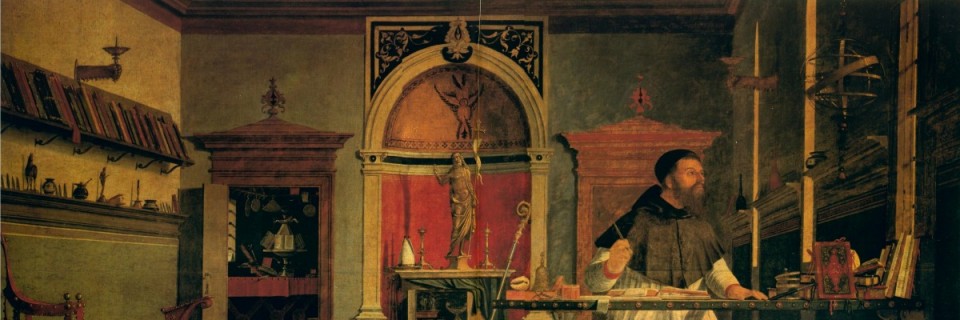
 Project Augustine