Home » Posts tagged 'church history' (Page 3)
Tag Archives: church history
UPDATE: Chapter 18 – Rome’s Renewal (1500 – 1700) – Witch Hunts, Huguenots, Teresa of Avila, and John of the Cross
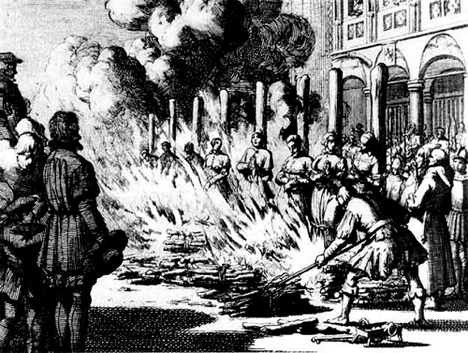
Women burned after being accused of witchcraft in Europe during the 1500s – 1700s.
Had another interesting session once again tonight.
Here are our submissions.
Ron dropped by and offered some interesting perspectives on the history of the Church in general. Many Protestants today criticize the Catholic Church for abuses of power throughout history, marginalizing others and succumbing to greed and accusing others of heresies; however, Protestants as we have seen are not immune at all as well and have succumbed to these vices just as much, if not more.
Chapter 17: Reformed Protestants and Reformation Crises (1560 – 1660)

Battle of Naseby, by an unknown artist. The victory of the Parliamentarian New Model Army, under Sir Thomas Fairfax and Oliver Cromwell, over the Royalist army, commanded by Prince Rupert, at the Battle of Naseby (June 14, 1645) marked the decisive turning point in the English Civil War.
Next Sunday, June 1 we will finish Chapter 17 by discussing the final two sections: Reformed Protestants, Confessionalization and Toleration (1560 – 1660) and Reformation Crises: The Thirty Years War and Britain.
Please write on one of the following topics:
- Discuss how Reformed Christianity/Reformed Protestantism triggered revolutions throughout Europe, especially the Netherlands, Scotland, and France during the 1560s. Why was this so?
- What was “confessionalization“? How did this affect Catholicism in Europe?
- Discuss the open toleration of other forms of Christianity, like the Anti-Trinitarians (i.e. ‘Socians’), in places like Transylvania and Poland-Lithuania.
- Discuss the background of the events leading up to the conquest of the kingdom of Bohemia by the Habsburg dynasty. How did Habsburg Emperor Ferdinand’s dismantling of Protestantism affect European politics and religion – especially between Protestants and Catholics?
- Discuss the theology of Dutch Reformed academic and theologian Jacob Arminius during the 1600’s.
- Discuss the importance and development of the King James Bible in 1611.
- Discuss how the policies of King Charles I and Archbishop of Canterbury Laud affected the Scottish and Irish churches. What were the effects of the English Civil War in 1642? How did the term “Anglican” arise from this time in English history?
Please submit your essays by Saturday, May 31.
John Calvin – Video Lecture by Prof. Tony Lane – Part 1
Video lecture by Prof. Tony Lane, Professor of Historical Theology, London School of Theology on John Calvin.
Presented by St. John’s Nottingham.
40 Maps that Explain the Middle East – vox.com

Map on how the Middle East gave Europe religion, three times
If you want a crash course on the history of the Middle East through maps from 9000 BC to the present day, then check out this site.
Highly informative in my opinion.
“The Story of the Jews” – Episode 2 – Among Believers
Last week, as our group was discussing the expulsion of Jews from Spain in 1492, we also talked about the roots of antisemitism in church history. Our understanding was a bit foggy at best.
However, after watching the second episode of the PBS series “The Story of the Jews”, narrated by Simon Schama, I gained a better understanding of the long, and very shameful history, of Christians murdering and persecuting Jews throughout the centuries. And of course, Muslims have had a long history of persecuting Jews as well.
Schama places the Christian roots of antisemitism with the writings of St. Paul, and then hatred toward Jews reached its heights with the fiery preachings of John Chrysostom, Archbishop of Constantinople, during the 4th century AD who associated Jews with demons and the Devil, and as “Christ-killers”.
When you think about it, as Mr. Schama discusses in this episode, having strictly monotheistic Jews accept the Trinity or the deity of Christ would not only be unacceptable to them, but downright weird. Even claims that Jesus was the Messiah as prophesied in the Old Testament by the prophets seems unconscionable to Jews who believe that with the coming of the Messiah, he would usher in an age of peace throughout the world – but as you know from history, the world has hardly been a place of universal peace after Jesus.
Watch the episode here.
Chapter 16: Perspectives of the True Church (1300 – 1517) – Part II

King Fernando (1452 – 1516) and Queen Isabel (1451 – 1504) of Spain
For next Thursday, April 10 we will cover the last three sections of Chapter 16: Old Worlds Bring New: Humanism (1300 – 1500), Reforming the Church in the Last Days (1500), Erasmus: New Beginnings?
“The 160-Year Christian History Behind What’s Happening in Ukraine” – Christianity Today

Here is a great article in christianitytoday.com about the history of Crimea and the Crimean War (1853 – 56) – great background to what is happening in that region and the Ukraine today.
After reading about the history of the Orthodox faith in Russia for the past couple of months, when you read this article, things will seem more familiar even though we haven’t delved into this later part of Russian Orthodox Church history yet.
Engineering an Empire – The Byzantines
We just concluded our readings about the rise and fall of the Byzantine Empire.
One of my favorite programs that aired on the History Channel was a series titled “Engineering an Empire” hosted by Peter Weller, lecturer of ancient history at Syracuse University – yes, that Peter Weller who starred in “Robocop”, “The Adventures of Buckaroo Banzai”, and most recently in last year’s “Startrek: Into Darkness”.
Submissions for Chapter 13: Part II – Byzantine Iconoclasm and Patriarch Photios

Here are our written submissions from last night.
Also, I caught an error in one of our links for Chapter 12, from Dec. 18, 2013. Here is the corrected link.
Good conversation from last night as we centered around the often uneasy relationship between religion (the institutionalized version) and politics. (And first time in a long while where we had the whole crew present in a meeting.)
Amanda pointed out that she felt that MacCulloch’s book was more about a “history of the church” rather than the “history of Christianity”. I think I understand her position. It’s a bit depressing to read about how corrupt and power-hungry people have been when reading about church history, even though they hide under the veneer that they are followers of Christ. I believe she wanted to read about accounts of believers in the early part of the church who were not only doing good deeds, but really living out their convictions for the love of Christ and for others.
I think one of the main underlying questions was: What does true Christianity really look like? Does it have to be defined by church denominations or traditions? (No, of course not, but…)
I posed the question, “Didn’t Christ die for the church?”
Diarmaid MacCulloch on his book “Christianity: The First Three Thousand Years”
“God is not the answer; He’s the question.”
Diarmaid MacCulloch, Prof. of History of the Church at Oxford University, talking about his book, Christianity: The First 3000 Years, that we are currently going over.
 Project Augustine