Home » Reformation
Category Archives: Reformation
A Look at Christmas – Some Different Viewpoints

Merry Christmas everyone!
Around the world, people (Christians and non-Christians alike) are celebrating this perennial winter holiday.
Here are some interesting articles I recently came upon that explores what the Bible says about the Virgin Birth (really technically the “Virgin Conception”) and the genre of the gospels as well.
“The Not-So Virgin Birth of God” and “Six Problems with the Virgin Birth: Biblical and Historical Perspective“.
And an interesting article on how the date of December 25 came to be celebrated as Jesus’ birthday.
Here are our group’s personal reflections on Christmas and the Virgin birth as well from earlier in the year.
Some things to chew on for this Christmas season.
UPDATE: Final Thoughts on Diarmaid MacCulloch’s “Christianity: The First Three Thousand Years”
Well, we’ve come to the end after two years of reading “Christianity: The First Three Thousand Years” and we share our final thoughts here.
Howard and Chris share what they have learned and gained from reading this book; Michael writes about the historical development of how Greek pagan philosophy seeped into Western theology and how it has affected our contemporary reading of the Bible; I share my thoughts on divine intervention (or non-intervention more specifically) and history or my attempt to understand God’s role in history after having read this book.
We hope and pray that we will use the knowledge gained from this session wisely. I believe that this is just the beginning of our journey into learning more about the history of the Church.
UPDATE – Chapter 21: Enlightenment: Ally or Enemy? (1492 – 1815) – Part I (1492 – 1700)

Benoît Louis Prévost, An engraving from the 1772 edition of the “Encyclopédie”. Truth, in the top center, is surrounded by light and unveiled by the figures to the right, Philosophy and Reason.
Today we delve into the first part of a series of studies on the Age of Enlightenment and its effects on Christianity.
Here, we delve into challenges to the authority of the Church and the Bible, the philosophy of Baruch de Spinoza, and the aftermath that the 1492 Expulsion of the Jews in Spain and Portugal had in fostering religious skepticism and doubt.
UPDATE: Chapter 20 Protestant Awakenings (1600 – 1800) – Part I: Protestants and American Colonization & The Fight for Protestant Survival (1600 – 1800)
William Penn, founder of Pennsylvania, (1644 – 1718)
We begin with the British colonization of eastern North America and the impact Protestantism had there.
Here are our essays concerning slavery, the Quakers, William Penn, and John Locke.
Also, Michael placed a late submission for Chapter 19 concerning the influence of pagan practices inherited from the Roman Empire into Christian traditions we often take for granted. Many Christians are quick to dismiss the often categorized “pagan” aspects of other religious traditions such as voodoo, without realizing the blatant paganism inherent within Christian practices itself. Before we quickly judge others, it’s best to know our history and where our beliefs and traditions originated from.
Chapter 20 – Protestant Awakenings (1600 – 1800): Part I

Puritans Land Near Salem, Mass.
For next Tuesday, July 15 please read the first two sections of Chapter 20: Protestant Awakenings – Protestants and American Colonization and The Fight for Protestant Survival (1600 – 1800).
Please write a one page summary on one of the following topics:
- How did early English settlers to North America use Protestant rhetoric to justify colonizing eastern North America in relation to Catholic settlers from Spain and France?
- Summarize how the Puritan and Reformed themes of covenant, community, and being in the “wilderness” formed early New England identity. What were the theological aims of the Puritans? Were they separatists?
- Describe how English Protestant evangelical aims were different than Catholic missionaries to the native Indians. Include the efforts of Roger Williams and John Eliot to the Native American population.
- Describe the efforts of William Penn, the Quakers, the formation of the Pennsylvania colony, and their belief in the freedom of religion.
- Summarize the reign of King James II of England and the political turmoil he caused. Who were the ‘Whigs’ and the ‘Tories’ and why were they important? Describe his relationship with Prince Willem of Orange of the Netherlands and his campaign against Catholics.
- How did John Locke appeal to the Bible to provide the basis for his philosophy of the social contract and raise doubts about a sacred monarchy?
- How did England become the major super-power of the world during this era in history? What events contributed to the expansion of the English empire? How did Britain make Protestantism to become the forefront of Christendom and Christianity?
Please submit by Monday, July 14.
UPDATE: Chapter 18 – Rome’s Renewal (1500 – 1700) – Witch Hunts, Huguenots, Teresa of Avila, and John of the Cross
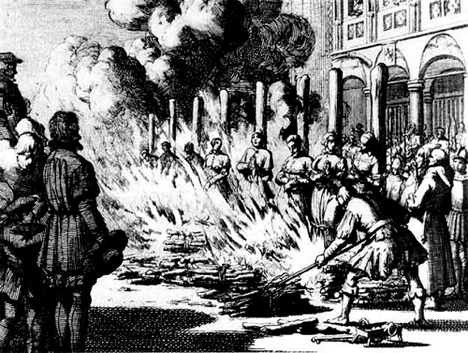
Women burned after being accused of witchcraft in Europe during the 1500s – 1700s.
Had another interesting session once again tonight.
Here are our submissions.
Ron dropped by and offered some interesting perspectives on the history of the Church in general. Many Protestants today criticize the Catholic Church for abuses of power throughout history, marginalizing others and succumbing to greed and accusing others of heresies; however, Protestants as we have seen are not immune at all as well and have succumbed to these vices just as much, if not more.
Questions for Chapter 18: Rome’s Renewal (1500 – 1700)

Pope Paul III approves the Formula Instituti of Ignatius of Loyola (1539)
Please read all of Chapter 18 in MacCulloch’s book where it centers around the Counter-Reformation by the Catholic Church from 1500 – 1700.
We will meet this Sunday to go over our essays.
Please write a summary on one of the following:
- Discuss the origins, development, rise, and importance of the Society of Jesus (or Jesuits) from its beginnings with Ignatius Loyola. What role did they play in the Counter-Reformation? Discuss their accomplishments in secondary education throughout Europe.
- Discuss the central tenets of the Council of Trent in 1545 and through 1563. Include issues laid out for Catholic catechism, liturgy, and issues about the authority of the Catholic Church. What was its greatest impact or lasting legacy?
- Discuss the impact and acceptance of the two mystics: Teresa of Avila and Juan de Yepes (John of the Cross).
- What were the events that led up to the Massacre of St. Bartholomew’s Day in 1572. How were relations between French Catholics and Huguenots affected from this incident?
- Why did Poland-Lithuania embrace Catholicism after being “such a fertile seminary of Protestant experiment”?
- Discuss the differing ways Protestants and Catholics began implementing unique styles of worship and services.
- Discuss why Galileo was placed in prison for his scientific views. What historical circumstances led to his verdict by the Catholic Church?
- Why did the persecution and hunting of witches happen during this time in Europe and North America? Why did it eventually cease?
Please have your responses ready by this Saturday, June 14.
UPDATE: Chapter 17: A House Divided (1517 – 1660) Part III – Confessionalization, the Trinity, the Habsburg Empire and Bohemia

We have concluded Chapter 17 and here are our submissions.
We had an interesting discussion on the validity of the doctrine of the Trinity, mostly around the question whether or not the Holy Spirit was a person or just a description of the power of God. Even defining the word “person” is quite difficult when you come to think of it.
Again, we discussed how religious conflicts, especially the ones triggered by the Reformation and Calvinism in particular, across Europe could be indicative of the “true” or “invisible” church; in other words, how can we reconcile all the religious wars throughout history, purportedly fought for in the name of Christ, with the Christian message? Can it be reconciled given the fact all the Christian vs. Christian violence that has happened throughout history?
There’s a tendency by some to attribute “spiritual” or Satan into the mix as a cause of all this violence amongst Christians, but I doubt serious historians would ever accept such a reason- not just because most would find that silly, but also most would find it to be a rather naive and easy-way of thinking about such things without analyzing and critically thinking about all the factors involved.
There’s a trend you see throughout history, even beginning with the early church, where the greatest enemy of Christianity were Christians themselves.
Chapter 17: Reformed Protestants and Reformation Crises (1560 – 1660)

Battle of Naseby, by an unknown artist. The victory of the Parliamentarian New Model Army, under Sir Thomas Fairfax and Oliver Cromwell, over the Royalist army, commanded by Prince Rupert, at the Battle of Naseby (June 14, 1645) marked the decisive turning point in the English Civil War.
Next Sunday, June 1 we will finish Chapter 17 by discussing the final two sections: Reformed Protestants, Confessionalization and Toleration (1560 – 1660) and Reformation Crises: The Thirty Years War and Britain.
Please write on one of the following topics:
- Discuss how Reformed Christianity/Reformed Protestantism triggered revolutions throughout Europe, especially the Netherlands, Scotland, and France during the 1560s. Why was this so?
- What was “confessionalization“? How did this affect Catholicism in Europe?
- Discuss the open toleration of other forms of Christianity, like the Anti-Trinitarians (i.e. ‘Socians’), in places like Transylvania and Poland-Lithuania.
- Discuss the background of the events leading up to the conquest of the kingdom of Bohemia by the Habsburg dynasty. How did Habsburg Emperor Ferdinand’s dismantling of Protestantism affect European politics and religion – especially between Protestants and Catholics?
- Discuss the theology of Dutch Reformed academic and theologian Jacob Arminius during the 1600’s.
- Discuss the importance and development of the King James Bible in 1611.
- Discuss how the policies of King Charles I and Archbishop of Canterbury Laud affected the Scottish and Irish churches. What were the effects of the English Civil War in 1642? How did the term “Anglican” arise from this time in English history?
Please submit your essays by Saturday, May 31.
John Calvin – Video Lecture by Prof. Tony Lane – Part 1
Video lecture by Prof. Tony Lane, Professor of Historical Theology, London School of Theology on John Calvin.
Presented by St. John’s Nottingham.
 Project Augustine