Home » Articles posted by Project Augustine (Page 13)
Author Archives: Project Augustine
Chapter 20 – Protestant Awakenings (1600 – 1800): Part I

Puritans Land Near Salem, Mass.
For next Tuesday, July 15 please read the first two sections of Chapter 20: Protestant Awakenings – Protestants and American Colonization and The Fight for Protestant Survival (1600 – 1800).
Please write a one page summary on one of the following topics:
- How did early English settlers to North America use Protestant rhetoric to justify colonizing eastern North America in relation to Catholic settlers from Spain and France?
- Summarize how the Puritan and Reformed themes of covenant, community, and being in the “wilderness” formed early New England identity. What were the theological aims of the Puritans? Were they separatists?
- Describe how English Protestant evangelical aims were different than Catholic missionaries to the native Indians. Include the efforts of Roger Williams and John Eliot to the Native American population.
- Describe the efforts of William Penn, the Quakers, the formation of the Pennsylvania colony, and their belief in the freedom of religion.
- Summarize the reign of King James II of England and the political turmoil he caused. Who were the ‘Whigs’ and the ‘Tories’ and why were they important? Describe his relationship with Prince Willem of Orange of the Netherlands and his campaign against Catholics.
- How did John Locke appeal to the Bible to provide the basis for his philosophy of the social contract and raise doubts about a sacred monarchy?
- How did England become the major super-power of the world during this era in history? What events contributed to the expansion of the English empire? How did Britain make Protestantism to become the forefront of Christendom and Christianity?
Please submit by Monday, July 14.
The Hidden Agenda Behind the NIV Bible

NIV- An unreliable translation of the Bible?
I was exposed to how prone to error the NIV translation of the Bible was in the past, but not to this extent!
(I myself prefer the NASB, NRSV, or the ESV versions of the Bible. The only times I read or encounter the NIV these days are Sundays at church.)
The NIV is arguably the most popular translation of the Bible in America, or at least one of the most popular throughout the world. Therefore, could millions of Christians over the years been misled in our understanding of the Bible by the NIV translators?
Lots of times, we want the Bible (or even God for that matter) to fit into our own image and conform to our view of the world or reality, and not the other way around. It seems as if those who came up with the NIV seem to have placed the conservative evangelical doctrine of the infallibility and inerrancy of Scripture front and foremost, and let that be the driving motivation behind the translation, which then leads to gross misinterpretations and even erroneous belief systems.
Chapter 19: A Worldwide Faith (1500 – 1800)

Conquistadors decimating the Inca Empire
For this Sunday, we will go over Chapter 19: A Worldwide Faith (1500 – 1800).
Rather depressing (don’t know if that’s the right word) chapter to read personally, especially the brutal treatment of the native populations in the Americas and the slave trade in Africa.
Please write a summary or essay on one of the following:
- What was the Catholic Church’s involvement and stance of the early Western conquests and missionary work? For instance, how did Pope Julius II’s Patronato, which gave the Spanish Empire exclusive rights to preach the Gospel in new territories, as well as conquistadors who saw themselves as part of the Reconquista or part of the crusade in Europe to destroy Spanish Islam and Judaism, play as a factor in the treatment of the native population in the Americas?
- Explain the efforts of some Dominicans and Franciscans who protested against the brutal treatments of the natives. How did the ideas of the Franciscan Bartolome de las Casas lead directly to the enslavement of Africans and their coming to the Americas?
- Discuss how exclusive attitudes of Christian monopoly culture when dealing with the native culture and religions changed the landscape of the Americas. How did the apocalyptic End Time beliefs of the Iberian Franciscans factor into their missionary work? Describe how Christianity in the Americas evolved to become of mixture of native culture and Western Christianity.
- Describe the missions to Asia by the Jesuit Francis Xavier in 1542. How were their attitude and approach unlike the Iberian missions to the Americas? What were some tactics Jesuits used to reach out to the Chinese population who were antagonistic to Western culture and religion?
- Explain the reasons why Christian missions to Japan failed for the most part.
- Discuss the Church’s involvement with the African slave trade. Was the Catholic Church for or against the slave trade? Did their attitudes change later on?
- Explain how native African beliefs mixed with Catholicism to form syncretistic variations like voodoo in French Haiti, Candomble in Brazil, and the Santeria of Cuba.
Please submit you writings by Saturday, June 28.
UPDATE: Chapter 18 – Rome’s Renewal (1500 – 1700) – Witch Hunts, Huguenots, Teresa of Avila, and John of the Cross
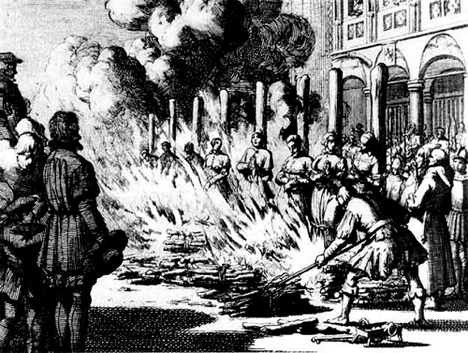
Women burned after being accused of witchcraft in Europe during the 1500s – 1700s.
Had another interesting session once again tonight.
Here are our submissions.
Ron dropped by and offered some interesting perspectives on the history of the Church in general. Many Protestants today criticize the Catholic Church for abuses of power throughout history, marginalizing others and succumbing to greed and accusing others of heresies; however, Protestants as we have seen are not immune at all as well and have succumbed to these vices just as much, if not more.
Questions for Chapter 18: Rome’s Renewal (1500 – 1700)

Pope Paul III approves the Formula Instituti of Ignatius of Loyola (1539)
Please read all of Chapter 18 in MacCulloch’s book where it centers around the Counter-Reformation by the Catholic Church from 1500 – 1700.
We will meet this Sunday to go over our essays.
Please write a summary on one of the following:
- Discuss the origins, development, rise, and importance of the Society of Jesus (or Jesuits) from its beginnings with Ignatius Loyola. What role did they play in the Counter-Reformation? Discuss their accomplishments in secondary education throughout Europe.
- Discuss the central tenets of the Council of Trent in 1545 and through 1563. Include issues laid out for Catholic catechism, liturgy, and issues about the authority of the Catholic Church. What was its greatest impact or lasting legacy?
- Discuss the impact and acceptance of the two mystics: Teresa of Avila and Juan de Yepes (John of the Cross).
- What were the events that led up to the Massacre of St. Bartholomew’s Day in 1572. How were relations between French Catholics and Huguenots affected from this incident?
- Why did Poland-Lithuania embrace Catholicism after being “such a fertile seminary of Protestant experiment”?
- Discuss the differing ways Protestants and Catholics began implementing unique styles of worship and services.
- Discuss why Galileo was placed in prison for his scientific views. What historical circumstances led to his verdict by the Catholic Church?
- Why did the persecution and hunting of witches happen during this time in Europe and North America? Why did it eventually cease?
Please have your responses ready by this Saturday, June 14.
UPDATE: Chapter 17: A House Divided (1517 – 1660) Part III – Confessionalization, the Trinity, the Habsburg Empire and Bohemia

We have concluded Chapter 17 and here are our submissions.
We had an interesting discussion on the validity of the doctrine of the Trinity, mostly around the question whether or not the Holy Spirit was a person or just a description of the power of God. Even defining the word “person” is quite difficult when you come to think of it.
Again, we discussed how religious conflicts, especially the ones triggered by the Reformation and Calvinism in particular, across Europe could be indicative of the “true” or “invisible” church; in other words, how can we reconcile all the religious wars throughout history, purportedly fought for in the name of Christ, with the Christian message? Can it be reconciled given the fact all the Christian vs. Christian violence that has happened throughout history?
There’s a tendency by some to attribute “spiritual” or Satan into the mix as a cause of all this violence amongst Christians, but I doubt serious historians would ever accept such a reason- not just because most would find that silly, but also most would find it to be a rather naive and easy-way of thinking about such things without analyzing and critically thinking about all the factors involved.
There’s a trend you see throughout history, even beginning with the early church, where the greatest enemy of Christianity were Christians themselves.
Chapter 17: Reformed Protestants and Reformation Crises (1560 – 1660)

Battle of Naseby, by an unknown artist. The victory of the Parliamentarian New Model Army, under Sir Thomas Fairfax and Oliver Cromwell, over the Royalist army, commanded by Prince Rupert, at the Battle of Naseby (June 14, 1645) marked the decisive turning point in the English Civil War.
Next Sunday, June 1 we will finish Chapter 17 by discussing the final two sections: Reformed Protestants, Confessionalization and Toleration (1560 – 1660) and Reformation Crises: The Thirty Years War and Britain.
Please write on one of the following topics:
- Discuss how Reformed Christianity/Reformed Protestantism triggered revolutions throughout Europe, especially the Netherlands, Scotland, and France during the 1560s. Why was this so?
- What was “confessionalization“? How did this affect Catholicism in Europe?
- Discuss the open toleration of other forms of Christianity, like the Anti-Trinitarians (i.e. ‘Socians’), in places like Transylvania and Poland-Lithuania.
- Discuss the background of the events leading up to the conquest of the kingdom of Bohemia by the Habsburg dynasty. How did Habsburg Emperor Ferdinand’s dismantling of Protestantism affect European politics and religion – especially between Protestants and Catholics?
- Discuss the theology of Dutch Reformed academic and theologian Jacob Arminius during the 1600’s.
- Discuss the importance and development of the King James Bible in 1611.
- Discuss how the policies of King Charles I and Archbishop of Canterbury Laud affected the Scottish and Irish churches. What were the effects of the English Civil War in 1642? How did the term “Anglican” arise from this time in English history?
Please submit your essays by Saturday, May 31.
John Calvin – Video Lecture by Prof. Tony Lane – Part 1
Video lecture by Prof. Tony Lane, Professor of Historical Theology, London School of Theology on John Calvin.
Presented by St. John’s Nottingham.
A Critical Assessment of the Reformed Doctrines of Original Sin and Solus Christus (Salvation in Christ Alone)

So yesterday, we had an interesting discussion on the doctrines of Solus Christus (Salvation in Christ Alone) and Original Sin.
I just want to make this clear that these critical assessments of these core Reformed doctrines are in no way to undermine or question the validity of the Christian faith. We raise these issues and challenges to strengthen the faith and understand what Christians actually believe in.
However, I understand how emotionally involved persons who have adopted these traditions and doctrines to heart are and who take this personally. And I’m fully aware how nasty debates can become, even between faithful brothers and sisters in Christ. We do it because we take the truth seriously. We don’t want to engage in polemics attacking or pushing someone to adopt or reject another point of view. Its purpose is to raise thoughtful questions and engage and spur others to think things through.
We live in a complex and interconnected world today and many worldviews will come into contact with one another. It is important to take other viewpoints into consideration and call out those that do not make sense, are flatly wrong, or seem antiquated.
We raise questions, not to cause people to doubt their faith, but more so to realize that an unexamined faith is not worth believing in (to modify Socrates’ famous quote that “An unexamined life is not worth living”).
We welcome thoughtful discussion and disagreements with the ideas and viewpoints we present here, so please do comment if you wish.
This is theology in action – faith seeking understanding.
 Project Augustine