Home » Posts tagged 'Catholic Church' (Page 2)
Tag Archives: Catholic Church
UPDATE: Chapter 21: Enlightenment: Ally or Enemy? (1492 – 1815) – Part III

This picture criticized the contradiction of the “Ancien Regime”. The Third Estate( the old man) is giving the First Estate(clergy) and the Second Estate(nobility) a piggyback.
Today, we concluded our studies on the Enlightenment and its effects on the Christian Church by discussing the origins and causes of the French Revolution and the rise of the middle-class afterwards.
Our essays can be found here.
Chapter 21: Enlightenment: Ally or Enemy? (1492 – 1815) – Part III – The French Revolution and its Aftermath

“Liberty Leading the People”, Eugene Delacroix, 1830 It commemorated the July Revolution of 1830 which toppled King Charles X of France. A woman personifying Liberty leads the people forward over the bodies of the fallen, holding the flag of the French Revolution – the tricolor flag which is still France’s flag today.
For our next meeting, we will be concluding our survey of the Enlightenment period by reading the last two sections of Chapter 21: The French Revolution (1789 – 1815) and Aftermath of Revolution: A Europe of Nation-States.
We’ve come a long way in our study of Christian history. Starting with the seeds of Western Civilization in ancient Greece, to the humble beginnings of the ministry of Jesus of Nazareth, the growth of the Church in Roman times, through the Middle Ages, the rise of the Catholic Church and the Christian Empire, the spread of Orthodox Christianity, the impact of the Reformation, the spread of Christianity throughout the entire world in Europe, Africa, Russia, Asia, and to North and South Americas, and now we come into the origins of the modern world we live in today starting with the Enlightenment period. Christianity and her Church have come a long way and have been through much change to say the very least.
Chapter 19: A Worldwide Faith (1500 – 1800)

Conquistadors decimating the Inca Empire
For this Sunday, we will go over Chapter 19: A Worldwide Faith (1500 – 1800).
Rather depressing (don’t know if that’s the right word) chapter to read personally, especially the brutal treatment of the native populations in the Americas and the slave trade in Africa.
Please write a summary or essay on one of the following:
- What was the Catholic Church’s involvement and stance of the early Western conquests and missionary work? For instance, how did Pope Julius II’s Patronato, which gave the Spanish Empire exclusive rights to preach the Gospel in new territories, as well as conquistadors who saw themselves as part of the Reconquista or part of the crusade in Europe to destroy Spanish Islam and Judaism, play as a factor in the treatment of the native population in the Americas?
- Explain the efforts of some Dominicans and Franciscans who protested against the brutal treatments of the natives. How did the ideas of the Franciscan Bartolome de las Casas lead directly to the enslavement of Africans and their coming to the Americas?
- Discuss how exclusive attitudes of Christian monopoly culture when dealing with the native culture and religions changed the landscape of the Americas. How did the apocalyptic End Time beliefs of the Iberian Franciscans factor into their missionary work? Describe how Christianity in the Americas evolved to become of mixture of native culture and Western Christianity.
- Describe the missions to Asia by the Jesuit Francis Xavier in 1542. How were their attitude and approach unlike the Iberian missions to the Americas? What were some tactics Jesuits used to reach out to the Chinese population who were antagonistic to Western culture and religion?
- Explain the reasons why Christian missions to Japan failed for the most part.
- Discuss the Church’s involvement with the African slave trade. Was the Catholic Church for or against the slave trade? Did their attitudes change later on?
- Explain how native African beliefs mixed with Catholicism to form syncretistic variations like voodoo in French Haiti, Candomble in Brazil, and the Santeria of Cuba.
Please submit you writings by Saturday, June 28.
UPDATE: Chapter 18 – Rome’s Renewal (1500 – 1700) – Witch Hunts, Huguenots, Teresa of Avila, and John of the Cross
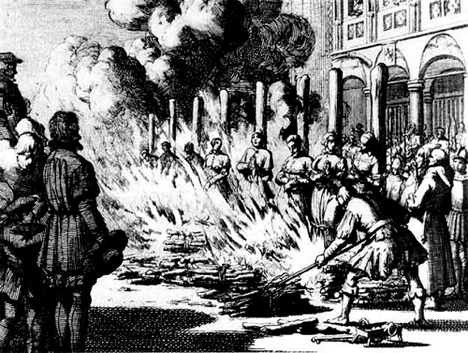
Women burned after being accused of witchcraft in Europe during the 1500s – 1700s.
Had another interesting session once again tonight.
Here are our submissions.
Ron dropped by and offered some interesting perspectives on the history of the Church in general. Many Protestants today criticize the Catholic Church for abuses of power throughout history, marginalizing others and succumbing to greed and accusing others of heresies; however, Protestants as we have seen are not immune at all as well and have succumbed to these vices just as much, if not more.
Questions for Chapter 18: Rome’s Renewal (1500 – 1700)

Pope Paul III approves the Formula Instituti of Ignatius of Loyola (1539)
Please read all of Chapter 18 in MacCulloch’s book where it centers around the Counter-Reformation by the Catholic Church from 1500 – 1700.
We will meet this Sunday to go over our essays.
Please write a summary on one of the following:
- Discuss the origins, development, rise, and importance of the Society of Jesus (or Jesuits) from its beginnings with Ignatius Loyola. What role did they play in the Counter-Reformation? Discuss their accomplishments in secondary education throughout Europe.
- Discuss the central tenets of the Council of Trent in 1545 and through 1563. Include issues laid out for Catholic catechism, liturgy, and issues about the authority of the Catholic Church. What was its greatest impact or lasting legacy?
- Discuss the impact and acceptance of the two mystics: Teresa of Avila and Juan de Yepes (John of the Cross).
- What were the events that led up to the Massacre of St. Bartholomew’s Day in 1572. How were relations between French Catholics and Huguenots affected from this incident?
- Why did Poland-Lithuania embrace Catholicism after being “such a fertile seminary of Protestant experiment”?
- Discuss the differing ways Protestants and Catholics began implementing unique styles of worship and services.
- Discuss why Galileo was placed in prison for his scientific views. What historical circumstances led to his verdict by the Catholic Church?
- Why did the persecution and hunting of witches happen during this time in Europe and North America? Why did it eventually cease?
Please have your responses ready by this Saturday, June 14.
Chapter 17: A House Divided (1517 – 1660) – Part I – Martin Luther and Huldrych Zwingli
For next week we will cover the first two sections of Chapter 17: A Door in Wittenberg and The Farmers’ War and Zwingli.

Martin Luther (1483 – 1546), by Lucas Cranach, 1529
We will be going into the heart of the Protestant Reformation by focusing on Martin Luther in Germany (or the Holy Roman Empire I should say specifically because the state of Germany didn’t exist during this time) and Huldrych Zwingli of the Swiss Confederacy.
New Updates: Chapter 16: Perspectives of the True Church (1300 – 1517) – Part I: The Black Death, Purgatory, Indulgences, Jan Hus and the Hussites

New updates can be found here. Lots of new material to go over.
Also, we reached over 1,000 views/hits to this site! Amazing! I’m amazed that people from Russia, England, Norway, and even Saudi Arabia have been checking out this site. I really do hope that Project Augustine and this site will continue to expand and reach more people the world over.
Tonight we had another interesting discussion on various topics. We discussed whether God still sends plagues down to mankind today. For instance, just as people in medieval Europe thought the Black Death was a punishment from God for their sins, in today’s world, can we say the same thing about AIDS being God’s punishment for homosexuality? Many believers still hold onto this belief, even in today’s scientific world. Let’s say, for argument’s sake, that this was the case – that God had sent the AIDS epidemic as punishment; how would that effect your understanding of God’s character?
Chapter 16: Perspectives of the True Church (1300 – 1517) – Part I: The Black Death, Purgatory, Nominalists, Lollards, and Hussites

“The Triumph of Death”, Pieter Brueghel the Elder, 1562
For next Wednesday, March 26, please read the first three sections of Chapter 16: The Church, Death and Purgatory (1300 – 1500); Papal Monarchy Challenged (1300 – 1500); Nominalists, Lollards and Hussites (1300 – 1500).
Please write a summary on one of the following topics:
- Discuss the impact the Black Death had upon the Catholic Church and people’s faith; also discuss the flagellant movement and anti-Semitism that was prevalent during this time.
- Discuss how the industry of Indulgences gained popularity during the time of the Black Death
- Discuss why Purgatory became so prevalent during after the 12th century.
- What was the significance of Council of Konstanz in 1417 with Pope Martin V and the Holy Roman Emperor Sigismund? What was the impact of the Conciliarists?
- Discuss the philosophy of William of Ockham and the Nominalists and why they were a threat to papal authority. Also how did printed texts and the printed Bible change the spiritual landscape of Europe during this time?
- Discuss the impact of John Wyclif in the 1370s and his followers the Lollards. What was the impact of the English translation of the Vulgate, and then subsequent translations of the Bible in the other European countries’ native language?
- Discuss the impact of Jan Hus and his Hussites during the 1400s in Prague. What impact did his execution have on the Czech Church and relations with the Catholic Church?
As you can tell, we are on the cusp of the Reformation revolution that is to come full force.
Essays will be posted next week.
Chapter 13: Faith in a New Rome – Part 2 – Icons and New Missions to the West; New Social media links

Emperors Constantine and Justinian Presenting Constantinople to the Virgin Mary Holding the Christ Child, Hagia Sophia
For next Tuesday, we will be finishing up the rest of Chapter 13 by covering the final two sections: Smashing Images: The Iconoclastic Controversy (726 – 843) and Photios and the New Missions to the West (850 – 900).
Before getting to the questions, please check out our new social media pages on facebook and twitter. Please join if you have accounts on both sites.
Why study Thomas Aquinas?
In Chapter 12 of Prof. MacCulloch’s book, he went over one of the great “doctors” of the Catholic Church, St. Thomas Aquinas.
In this clip, Dr.Simon Oliver from the University of Nottingham discusses why he devotes so much attention to the medieval Dominican theologian, Thomas Aquinas (1225-74); he argues that when someone today comes to grips with his thought, that learning experience trains one to think theologically.
Also added a link to the “Resources” Page for the University of Nottingham’s youtube channel. Great talks with professors about Christian theology, philosophy, church history, and religion.
 Project Augustine