Home » Church History (Page 3)
Category Archives: Church History
UPDATE: Chapter 22 – Part II – “God is Dead.”

It has been a long time coming, but here are our essays for the last half of Chapter 22, focusing on the rise of Christian fundamentalism, biblical criticism, the “quest for the historical Jesus”, and the philosophy of Friedrich Nietzsche.
It was good to get back in the swing of things after a little over a month and a half, and hopefully we’ll get the momentum back till we finish the book.
Chapter 22: Europe Re-enchanted or Disenchanted? (1815 – 1914) – Part II

Charles Darwin (1809 – 1882)
We’re still alive! Trust me.
We were on hiatus because everyone’s schedule seemed quite packed last month, but we’re itching to come back.
Next Wednesday, we’ll finish up with the last three sections of Chapter 22: British Protestantism and the Oxford Movement, Orthodoxy: Russia and Ottoman Decay, Masters of Suspicion: Geology, Biblical Criticism and Atheism.
Please write a one page summary of one of the following questions:
- Describe the aims of the ‘Oxford Movement’ during the 1830s in England. What were its aims? Who were the Tractarians? What was the relationship between the Church of England and the State like at this time? What was John Henry Newman’s role during this period? And what were their fears about the Roman Catholic Church?
- Discuss the relations between the Ottoman Empire and the Orthodox Church (especially the Russian Orthodox Church) after the Russo-Turkish War of 1768 – 74. Why did the Russian Church tolerate the tsar’s tight control over the Church? How did Jews and Greek Catholics fair during the ‘Holy Alliance’ formed by Tsar Alexander in 1815? Why was the ‘Holy Alliance’ formed in the first place?
- Describe the role the Russian Orthodox Church played in the independence of Serbia, Greece and Bulgaria from the Ottoman Empire. How was the Ottoman Empire affected afterwards, especially the Ottoman rulers’ pursuit of Tanzimat?
- Discuss the impact of Charles Darwin and his theory of evolution by natural selection. How did his books, On the Orgin of Species (1859) and The Descent of Man (1871), change how humankind was looked upon versus the biblical view of humankind? How are Darwin and his theory tied with his role in the anti-slavery/abolitionist movement? How did the relatively new science of geology change the perception of the Bible?
- Describe the rise of biblical criticism during the 19th century. Discuss the works of pastors and missionaries, like David Strauss and Albert Schweitzer, in their quests for the ‘historical Jesus’. How did perceptions of the Bible change because of higher criticism?
- Discuss the development of ‘Fundamentalism’ during the 1870s. What was it a reaction against? How and why did it form? How did it get its name? Discuss the roles Ira Sankey and D. L. Moody played in its rise. What are the central tenets of Fundamentalism?
- Discuss the philosophy of Friedrich Nietzsche. Describe his ‘God is dead’ philosophy. Discuss how his Lutheran upbringing molded some aspects of his anti-Christian rhetoric.
Hope to see everyone next Wednesday.
UPDATE: Chapter 22: Europe Re-enchanted or Disenchanted? (1815 – 1914) – Part I – First-wave feminism, Ultramontanism, and Hegel

This past Wednesday we had a rather lively discussion on the notion of visions in Christianity – visions of Mary for Catholics and just general visions by Pentecostals or other generally charismatic sects. It’s quite interesting that the Mother Mary almost never (to my knowledge) appears to Protestants – visions of Mary almost always occur to poor girls in small villages that are going through war or political strife. For Protestants, claims of visions or other prophetic utterances seem to be hit or miss according to the limited experiences we discuss from our own personal encounters.
There was also some discussion on whether or not missions (in general throughout history) isn’t a form of Western imperialization in some respects. We tend to go there and not only want to preach the gospel to them, but also hope and pray that they’ll receive the same benefits and even the comforts of an affluent Western lifestyle. Has the Western mindset of the gospel been diluted and mixed with the gospel of Western standard of living and materialism? There was also some thoughts as to whether or not Marcion was right in stating that the God of the Old Testament and the God of the New Testament are NOT one and the same. Christianity has moved so far away from Judaism and its understanding of God that when you compare the two, they seem worlds apart. It is arguable, but it’s an interesting thought nonetheless.
Here are our submissions from our meeting this Wednesday.
Chapter 22: Europe Re-enchanted or Disenchanted? (1815 – 1914) – Part I

“Die Proklamation des Deutschen Kaiserreiches” by Anton von Werner (1877), depicting the proclamation of the foundation of the German Second Reich (18 January 1871, Palace of Versailles). Left, on the podium (in black): Crown Prince Frederick (later Frederick III), his father Emperor Wilhelm I, and Frederick I of Baden, proposing a toast to the new emperor. Centre (in white): Otto von Bismarck, first Chancellor of Germany, Helmuth von Moltke the Elder, Prussian Chief of Staff.
For next Tuesday, Sept. 23 read the first 3 sections of Chapter 22: Europe Re-enchanted or Disenchanted? (1815 – 1914) – Catholicism Ascendant: Mary’s Triumph and the Challenge of Liberalism, Protestantism: Bibles and ‘First-Wave’ Feminism, and A Protestant Enlightenment: Schleiermacher, Hegel and Their Heirs.
UPDATE: Chapter 21: Enlightenment: Ally or Enemy? (1492 – 1815) – Part III

This picture criticized the contradiction of the “Ancien Regime”. The Third Estate( the old man) is giving the First Estate(clergy) and the Second Estate(nobility) a piggyback.
Today, we concluded our studies on the Enlightenment and its effects on the Christian Church by discussing the origins and causes of the French Revolution and the rise of the middle-class afterwards.
Our essays can be found here.
Chapter 21: Enlightenment: Ally or Enemy? (1492 – 1815) – Part III – The French Revolution and its Aftermath

“Liberty Leading the People”, Eugene Delacroix, 1830 It commemorated the July Revolution of 1830 which toppled King Charles X of France. A woman personifying Liberty leads the people forward over the bodies of the fallen, holding the flag of the French Revolution – the tricolor flag which is still France’s flag today.
For our next meeting, we will be concluding our survey of the Enlightenment period by reading the last two sections of Chapter 21: The French Revolution (1789 – 1815) and Aftermath of Revolution: A Europe of Nation-States.
We’ve come a long way in our study of Christian history. Starting with the seeds of Western Civilization in ancient Greece, to the humble beginnings of the ministry of Jesus of Nazareth, the growth of the Church in Roman times, through the Middle Ages, the rise of the Catholic Church and the Christian Empire, the spread of Orthodox Christianity, the impact of the Reformation, the spread of Christianity throughout the entire world in Europe, Africa, Russia, Asia, and to North and South Americas, and now we come into the origins of the modern world we live in today starting with the Enlightenment period. Christianity and her Church have come a long way and have been through much change to say the very least.

Chapter 21: Enlightenment: Ally or Enemy? (1492 – 1815) – Part II (1650 – 1750)
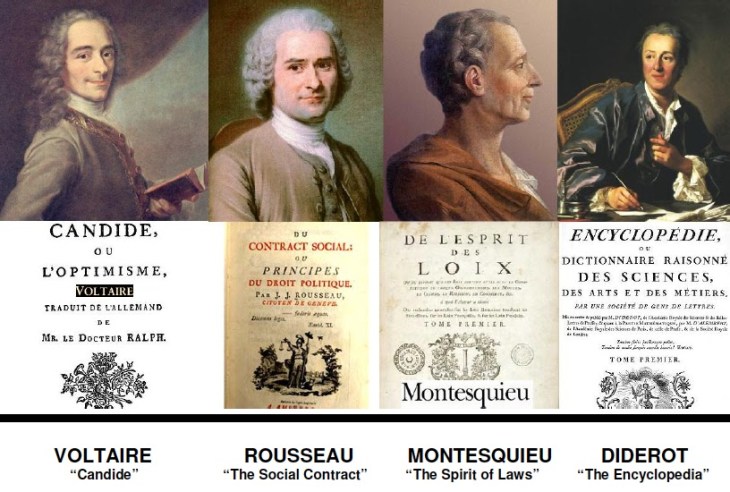
For our next meeting on Tuesday, August 26, please read the next three sections of Chapter 21: Social Watersheds in the Netherlands and England (1650 – 1750), Gender Roles in the Enlightenment, and Enlightenment in the Eighteenth Century.
UPDATE – Chapter 21: Enlightenment: Ally or Enemy? (1492 – 1815) – Part I (1492 – 1700)

Benoît Louis Prévost, An engraving from the 1772 edition of the “Encyclopédie”. Truth, in the top center, is surrounded by light and unveiled by the figures to the right, Philosophy and Reason.
Today we delve into the first part of a series of studies on the Age of Enlightenment and its effects on Christianity.
Here, we delve into challenges to the authority of the Church and the Bible, the philosophy of Baruch de Spinoza, and the aftermath that the 1492 Expulsion of the Jews in Spain and Portugal had in fostering religious skepticism and doubt.
Chapter 21: Enlightenment: Ally or Enemy? (1492 – 1815) – Part I

“A Philosopher lecturing with a Mechanical Planetary” by Joseph Wright, 1766
We will be having our next meeting on Tuesday, August 12.
Please read the first two sections of Chapter 21: Natural and Unnatural Philosophy (1492 – 1700) and Judaism, Skepticism, Deism (1492 – 1700), and please answer one of the following questions:
- What are the origins and purposes of Freemasonry or Masonic practice? What attitudes of the Reformation did they inherit? What connections did they have with more esoteric sources of sacred literature like hermetic books, Neoplatonic writings, and the Jewish Cabbala?
- Describe the impact of the Scientific Revolution of the 16th and 17th centuries. How did the study and progress of science (or ‘natural philosophy’) impact theology during this time? What were some of the religious ideas of Sir Isaac Newton? What was the primary focus of Francis Bacon’s project in extending human knowledge through empiricism and how did it relate to the story of Adam and Eve?
- Describe the impact the 1492 expulsion of the Jewish population in the Iberian peninsula had upon Europe as they spread to other territories. How did they view the Reformation? How did the culture of doubt and skepticism of religion come about as a result of oppressive Church practices like the Iberian Inquisitions? How did the religiously tolerant atmosphere of places like Amsterdam foster religious skepticism?
- Discuss the impact of the thoughts and works of Baruch de Spinoza. What were some of his beliefs about God and religion that many found so dangerous? Describe his two important works Tractatus Theologico-Politicus (1670) and Ethics (1677). Why were these works banned?
- Discuss how the Huguenots were behind many of the anti-religious writings during the Enlightenment. Explain how the historical criticism of the Bible during this time led to serious doubts about its divine inspiration.
- How did the observations of Pierre Bayle, Thomas Hobbes, early Quakers, Isaac La Peyrere, and the discovery of other races of people in the Americas affect thought about the authority of the Church and the authority of the Bible?
- What is deism and how did it gain prominence during the Enlightenment? How did Protestant Evangelicals and Pietist counteract deism?
I know some are really excited to read this part of history and the importance of the Enlightenment, so it should be fertile ground for some interesting discussions and insights in the upcoming weeks ahead. Really looking forward to our discussions.
Please submit your essays by Monday, August 11.
 Project Augustine