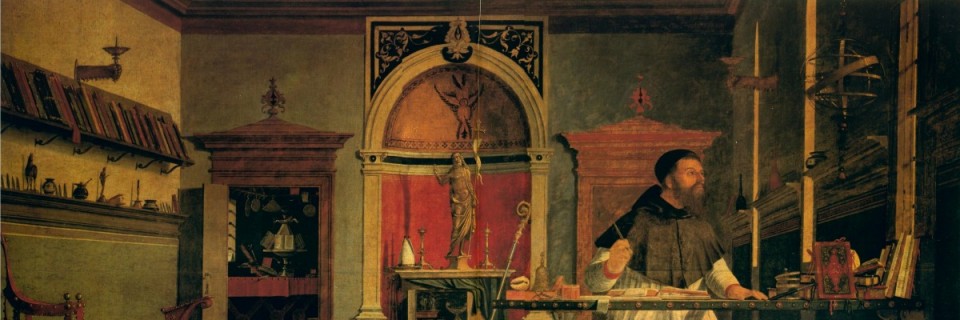
“The Conversion of St. Augustine” by Fra Angelico, (circa 1395–1455)
‘You called and cried out loud and shattered my deafness.
You were radiant and resplendent, you put to flight my blindness.
You were fragrant, and I drew in my breath and now pant after you.
I tasted you, and I feel but hunger and thirst for you.
You touched me, and I am set on fire to attain the peace which is yours.’
– Augustine of Hippo, Confessions (Book 10.27)
Starting in May, we will be taking an in-depth study into one of the most influential books ever written by one of the greatest and influential minds of the West, Confessions by Aurelius Augustinus Hipponensis, otherwise known as Augustine of Hippo (or St. Augustine).
Perhaps you had to read Confessions as a requirement for your classics or liberal arts classes during college, but only spent a couple of sessions on it. Or maybe you read it a long time ago and now want to visit it again and ruminate on Augustine’s thoughts a bit more thoroughly now. Whatever the reason may be, we invite you to join us as we begin a new venture into the heart and mind of a man deeply and passionately committed to his faith and whose thoughts still resonate vibrantly till this day.
Russian Orthodox Church has enjoyed a resurgence since the end of atheist Soviet Communist rule in 1991. (Reuters)
This will be our next to last submissionson MacCulloch’s Christianity: The First Three Thousand Years: two essays on the relevancy of the doctrine of hell in churches today and how the Orthodox Church has changed after the collapse of communism in Russia after 1991.
In our last entry for this series, coming next month, we will reflect on how a knowledge of Church history has impacted our understanding of the Christian faith.
Statue of Satan at the Satanic Temple in Detroit, MI.
Great article and post on the development of Satan/the Devil in Judeo-Christian thought and theology through the centuries over at isthatinthebible.wordpress.com.
Plant neurobiology is a fascinating area of research in science that is going on today that explores how plants behave, learn, communicate, and respond with each other and their environment.
Here are some of my thoughtson this and how this research might relate with theology.
I was saddened to hear of the passing of one of the greatest theologians of the 20th century, Wolfhart Pannenberg, last Friday on September 5.
On and off, I’ve been reading his magnum opus, Systematic Theology vols. 1 – 3, along with his Jesus – God and Man, Metaphysics and the Idea of God, and Theology and the Philosophy of Science.
I’m also currently reading a book about his theology edited by one of his students, Philip Clayton, titled “The Theology of Wolfhart Pannenberg: Twelve American Critiques, with an Autobiographical Essay and Response“.
You can read Clayton’s obituary of Pannenberg here.
After being reintroduced to Immanuel Kant’s thought after our last session on MacCulloch’s book, his philosophy intrigues me and I see the inherent and serious challenges Kant poses in reference to theistic epistemology.
A good introduction to Kant’s philosophy of religion can be read hereon the Stanford Encycopedia of Philosophy website. (A supplemental entry on Kant’s influence on religion can be found here.)
After writing my last church history essay on Kant, that prompted me to delve deeper into Kant’s philosophy and his thoughts about God, religious epistemology and morality. One book I got in specific reference to Kant’s subsequent impact on theology is Kant and Theology at the Boundaries of Reason by Chris L. Firestone.
Throughout my life I’ve experienced a wide range of beliefs: from Evangelical to agnostic, then to atheist, then a period of dabbling in Eastern religions, to Pentecostal, then to Presbyterian/Calvinist, and now, well, to where I am today let’s just say.
Once you think you have grasped a firm understanding of God, you come across something that catches you off-guard and makes you re-evaluate everything you’ve believed in. As St. Augustine once said, “God is not what you imagine or what you think you understand. If you understand, you have failed.“
Over the recent years, as I have delved a bit more into the scientific underpinnings of God and theology, as well as my ruminations of the Bible, I’ve adopted more of a “non-interventionist”viewpoint of God.
In most churches today, if you would answer in the affirmative to the first question and negative to the second, you’d likely be branded a heretic or “liberal”. Many people seem to be so set in his or her ways that they won’t even carefully consider a different opinion or viewpoint about God or other theological matters. But it makes sense – for many, his or her view of God that they’ve grown up with or have adopted over the years, they’ve formed a close, emotional (not just psychological or spiritual) bond to it that’s hard to let go.
The very notion of entertaining the thought of God NOT knowing the future or that he can experience new things, or that he is NOT in absolute, complete control of everything (his omniscience, omnipotence, etc.) can be quite (emotionally) unsettling to even consider. (As a criticism of open theism, it may seem to anthropomorphize God a bit too much.)
Much of theology these days (and same goes to a vast majority of the view of God that is communicated through pulpits every week on any given Sunday) seem to be stuck in medieval or Reformation times, and seem to be unwilling to budge. As you know, much of history, science, technology, etc. has changed and progressed since that time, and the Church has had a hard time (or a very stubborn reluctance in) catching up to the rapid changes that are happening in our modern world, so it faces a crisis of remaining relevant to future generations if the Church continues on this trend I believe.
Perhaps our theology and understanding of God need to be updated.
Interesting viewpoints on God’s nature and action according to open theism.
From the website:
Does God know all future events? Only if the future is in some real sense already determined. God, to be God, must know every true proposition, including all about the future. But if the future is truly ‘open’, not even God could know the future because there are no true facts about the future to know. Why is this disturbing?
Project Augustine started off with going through all of the 2nd Edition of Daniel Migliore’s Faith Seeking Understanding which you will find herein July of 2012.
According to his article, Mr. Migliore will include a brand new section of an imaginary conversation between German philosopher Friedrich Nietzsche and German theologian Karl Barth.
In my dialogue I try to avoid giving all the good lines to one of the speakers and reducing the other to a mere foil. My reason for doing so is that Nietzsche’s critique, even if dated, is in some respects devastating, and if I understand Barth’s way of doing theology aright, his response to the atheist challenge is not to try to defeat it by a clever apologetic strategy but instead simply to present as clearly as he can the Christian understanding of God centered in the person and work of Jesus Christ as attested in Scripture.
Our group took great joy going over Prof. Migliore’s book and we look forward to the new edition coming out next month.
Daniel L. Migliore is Charles Hodge Professor Emeritus of Systematic Theology at Princeton Theological Seminary


 Project Augustine