“The rich people of Rome had a great education. They were often schooled and were taught by their own private tutor, at home they would go to schools. The schools were boys only. All the learning was based from fear, The boys would be beaten for any offence. They did this because they figured if children fear getting the wrong answer they will get it correct. If a student were to get lots of answers wrong they would be held down and beaten with a leather strap. If you were poor chances are you would be able to read and write , but you would not be able to have your own tutor or be able to go to school. ” (source: https://historicalroots.wikispaces.com/Ancient+Romans) Augustine wrote about how he was beaten at school for bad performance. He writes, “I was still a boy when I first began to pray to you, my Help and Refuge. I used to prattle away to you, and though I was small, my devotion was great when I begged you not to let me be beaten at school. Sometimes, for my own good, you did not grant my prayer, and then my elders and even my parents, who certainly wished me no harm, would laugh at the beating I got – and in those days beatings were my one great bugbear.” (Confessions, Book I, Chapter 9)
In these chapters, Augustine describes his early education and what his childhood was like.
Here are some interesting facts about the time in which Augustine lived in that will provide some background information to clarify some historical details.
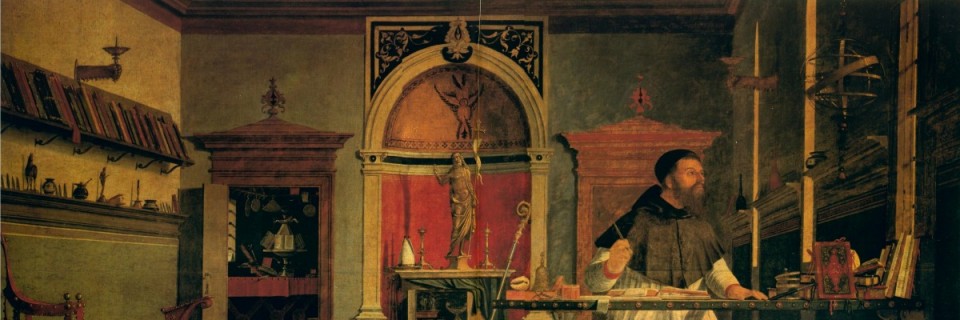
“St. Augustine Writing in His Cell”, Sandro Botticelli (1445 – 1510), Florence, Galleria degli Uffizi, c. 1490 – 94.
This past Thursday we had our first fruitful discussion of Augustine’s Confessions.
We had interesting discussions on topics about who makes the first step in reaching out to us: God or us? Musings on life and death (even reincarnation) and the ‘sinfulness’ of infants and babies were discussed.
Don’t let this baby’s unbearable cuteness deceive you. She’s a helpless, natural born sinner according to Augustine.
Hi everyone, we will be covering Book I, chapters 1 – 10.
Augustine titled his deeply philosophical and theological autobiography Confessions to implicate two aspects of the form the work would take. To ‘confess’, in Augustine’s time, meant both to give an account of one’s faults to God and to praise God or to speak one’s love for God. These two aims come together in the Confessions in an elegant but complex sense: Augustine narrates his ascent from sinfulness to faithfulness not simply for the practical edification of his readers, but also because he believes that his narrative itself is really a story about God’s greatness and of the fundamental love all things have for Him. Thus, in the Confessions form equals content to a large degree—the natural form for Augustine’s story of redemption to take would be a direct address to God, since it is God who must be thanked for such redemption. (That said, a direct address to God was a highly original form for Augustine to have used at the time).
Before we delve into Confessions, we will start exploring the development of Augustine’s philosophy and theology.
For a while, Augustine had been influenced by Manichaeism, a Persian adaptation of Christianity, which added in Zoroastrianism, speculative philosophy and superstition. Augustine was a Manichee for nine years. Then during a trip to Rome in 383, due to his education in the liberal arts, he began to question Manichaeism when he saw that its understanding of the universe owed more to astrology than astronomy.
The next year, he met the formidable figure of Ambrose, bishop of Milan. His great intellect and fiery sermons left a deep impression on Augustine. In Ambrose, Augustine found someone who could communicate at his own intellectual level, further confirming his rejection of the Manichees and opening the way for his return to the Christian faith.
I know that I stated that we’d be doing Augustine’s Confessions later on this month, but I’ve decided to hold off a bit longer to see if we can recruit some more people into the group, so we will not begin until June.
In the meantime, we will spend the rest of the month getting to know Augustine and the world he lived in better.
The video above gives an overview of Augustine’s philosophy and the world he lived in, which is vital to understand what and why he wrote. Although much of the video focuses on his monumental The City of God, we still get a good general overall sense of his beliefs, especially his political philosophy, and why he is still relevant today.
“The Conversion of St. Augustine” by Fra Angelico, (circa 1395–1455)
‘You called and cried out loud and shattered my deafness.
You were radiant and resplendent, you put to flight my blindness.
You were fragrant, and I drew in my breath and now pant after you.
I tasted you, and I feel but hunger and thirst for you.
You touched me, and I am set on fire to attain the peace which is yours.’
– Augustine of Hippo, Confessions (Book 10.27)
Starting in May, we will be taking an in-depth study into one of the most influential books ever written by one of the greatest and influential minds of the West, Confessions by Aurelius Augustinus Hipponensis, otherwise known as Augustine of Hippo (or St. Augustine).
Perhaps you had to read Confessions as a requirement for your classics or liberal arts classes during college, but only spent a couple of sessions on it. Or maybe you read it a long time ago and now want to visit it again and ruminate on Augustine’s thoughts a bit more thoroughly now. Whatever the reason may be, we invite you to join us as we begin a new venture into the heart and mind of a man deeply and passionately committed to his faith and whose thoughts still resonate vibrantly till this day.


 Project Augustine