Home » Posts tagged 'The Confessions of St. Augustine' (Page 2)
Tag Archives: The Confessions of St. Augustine
UPDATE: “Confessions” – Book VII: Chatpers 1 -10

St. Augustine Sacrificing to a Manichean Idol, 15th century, unknown Flemish master
Here are our submissions from last week on Confessions: Book VII – Chapters 1 – 10. We wrote on the topics of the philosophy and theology of evil, God’s relation to his creation, questions on whether or not God still speaks to us today, an overview of Manichean theology and how its views are still present in some way in today’s church.
Here is a late submission from the last book by Doris that you will find at the very end of the page.
We will finish up Book VII next week.
“Confessions” – Book VII – Chapters 1 – 10

“Lucifer, the Fallen Angel” by Gustave Dore (1832 – 1883)
Before mentioning the questions, please read Michael’s submission from last session here at the end.
We will begin Book VII: Chapters 1 – 10 of Confessions.
Although Augustine has been using Neoplatonic terms and ideas throughout the Confessions it’s here in Book VII that he reaches the point when he first reads Neoplatonic philosophy. This is a pivitol moment for the young Augustine, who finds in Neoplatonism a way of reconciling his long pursuit of philosophy with his new and serious faith in Christianity. The union of this philosophy and this theology will guide his work (including the Confessions) for the rest of his life.
UPDATE: “Confessions: Book VI – Chapters 9 – 16

Saint Augustine, detail from the Doctors of the Church Cycle, 1487-1492, fresco, Church of the Santissima Annunziata, Franciscan Monastery, Cortemaggiore, Emilia-Romagna. Italy, 15th century.
We conclude Book VI of “Confessions” with essays on self-interest vs. public interest in political offices, the role of the Church and her teachings on premarital sex, and thoughts on universal salvation and a glimpse into the true cost of forgiveness and grace.
Read them here.
Confessions: Book VI – Chapters 9 – 16
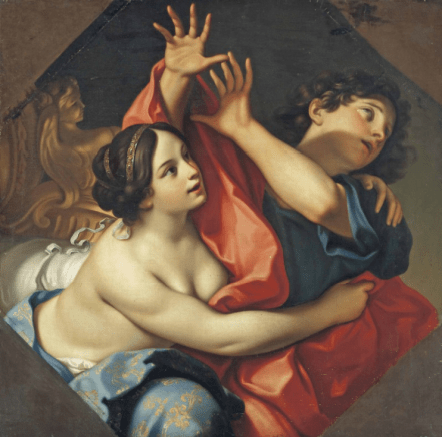
“Joseph and Potiphar’s Wife”, Carlo Cignani (Italian, 1628 – 1719)
We will finish Book VI of Confessions, where Augustine deals with issues of the pursuit of truth, his struggles with lust, the afterlife, and final judgment.
UPDATE: “Confessions”: Book VI – Chapters 1 – 8

Here are our essays for Book VI: Chapters 1 – 8, where we discuss about materialism and happiness, and on the culture of anti-intellectualism in American churches in general and what it means to love God with all your mind.
Confessions – Book VI: Chapters 1 – 8
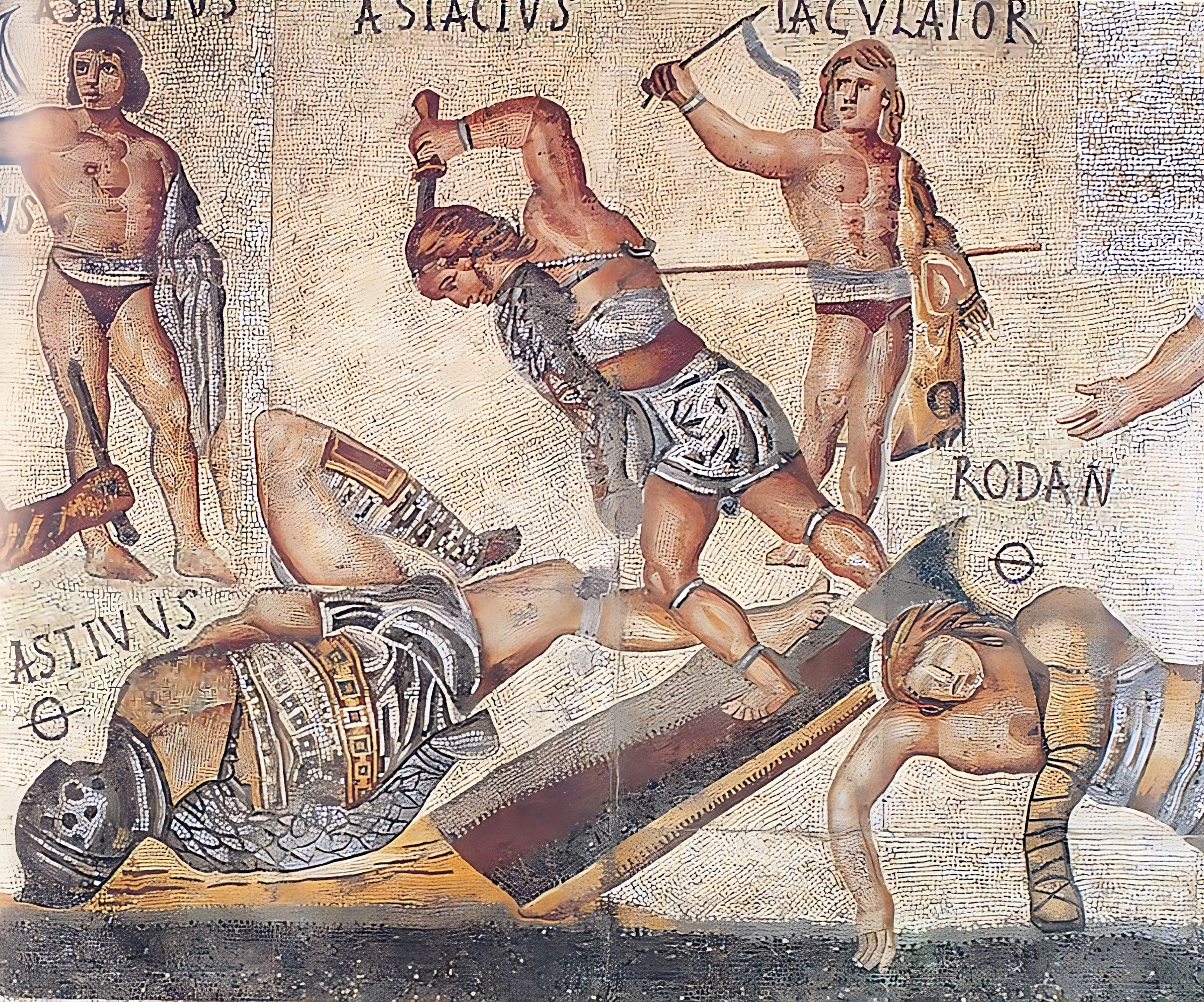
Detail of the Gladiator Mosaic, 4th century CE. Augustine’s friend Alypius became obsessed with gladiatorial shows.
Starting from Book VI and onward through Book VIII, Augustine describes his conversion to the Christian faith. It is good to bear in mind that he depicts conversion (or at least his own personal conversion) as a long process and not as a single event.
He devotes a large amount of Book VI to the people in his life in Milan: his mother Monica; Ambrose; and two friends from Africa, Alypius and Nebridius.
Please write on one of the following questions:
UPDATE: “Confessions” – Book V: Chapters 8 – 13

We had our first meeting back from over a month this past Sunday. We were a bit rusty in the beginning but we quickly picked up from right where we were before.
We went over Book V: Chapters 8 – 13 of Augustine’s “Confessions.” We discussed about whether or not we should read the Bible literally, if Christianity is meaningless without an afterlife, the role of doubt and skepticism in matters of faith, whether or not your sincerity and way of living affects answers to prayer, how we “picture” God when we pray, and whether or not the concept or reality of evil has relevance only in human terms.
You can find our essays here.
UPDATE: “Confessions: Book II”

“St. Augustine”, Michelangelo Caravaggio (1592-1610) , c. 1600, National Gallery of Canada
Here are our responses to Book II of Augustine’s Confessions.
We discussed the nature of sin and why if often feels good to us when we commit the act; the difference between lust and love; what role, if any, our free will plays in salvation; whether or not we are all born with a sense of morality (or right and wrong) within us, including a sense of the divine or God already ‘prebuilt’ within us; and the influence of neoplatonic thought on not only Augustine, but on Western Christian thought.
You can read our essays here.
“Confessions: Book II”

We will go over all of Book II of Confessions for our next meeting.
In this Book , Augustine describes the onset of adolescence (he was around sixteen at the time – c. 370-371 AD) and enters what he seems to consider the most lurid and sinful period of his life. He describes how he returned home after having spent a year in Madaura, a nearby city where he had gone to study rhetoric. His parents had now expended their meager resources for his schooling, which led the young Augustine to take a year off and give him the opportunity to get into some trouble. He “ran wild,” he writes, “in the jungle of erotic adventures…and became putrid in [God’s] sight.”
UPDATE: “Confessions” Book I, Chapters 11 – 20

Orthodox icon of St. Augustine – the patron saint of theologians
Here are our responses from last week on Augustine’s Confessions: Book I, Chapters 11 – 20.
We investigated Augustine’s thoughts on the relationship between the human condition and sin; baptism; mankind’s desire for wealth and fame; and his criticisms of educational institutions.
 Project Augustine