Home » Posts tagged 'sin' (Page 3)
Tag Archives: sin
“Confessions: Book II”

We will go over all of Book II of Confessions for our next meeting.
In this Book , Augustine describes the onset of adolescence (he was around sixteen at the time – c. 370-371 AD) and enters what he seems to consider the most lurid and sinful period of his life. He describes how he returned home after having spent a year in Madaura, a nearby city where he had gone to study rhetoric. His parents had now expended their meager resources for his schooling, which led the young Augustine to take a year off and give him the opportunity to get into some trouble. He “ran wild,” he writes, “in the jungle of erotic adventures…and became putrid in [God’s] sight.”
UPDATE: “Confessions” Book I, Chapters 11 – 20

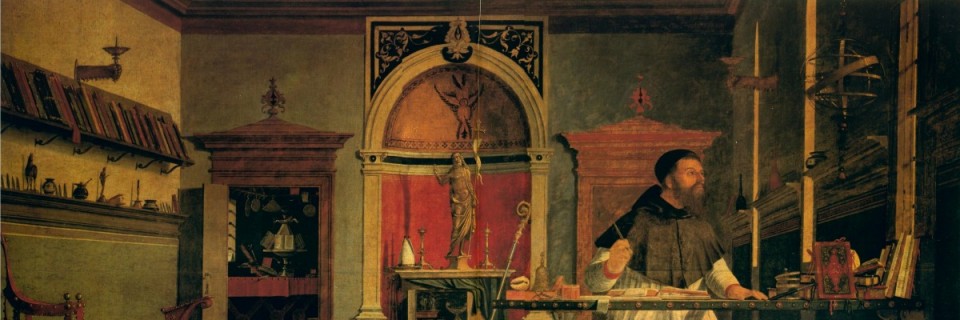
Orthodox icon of St. Augustine – the patron saint of theologians
Here are our responses from last week on Augustine’s Confessions: Book I, Chapters 11 – 20.
We investigated Augustine’s thoughts on the relationship between the human condition and sin; baptism; mankind’s desire for wealth and fame; and his criticisms of educational institutions.
Questions for ‘Confessions’ – Book I, Chapters 11 – 20

“The rich people of Rome had a great education. They were often schooled and were taught by their own private tutor, at home they would go to schools. The schools were boys only. All the learning was based from fear, The boys would be beaten for any offence. They did this because they figured if children fear getting the wrong answer they will get it correct. If a student were to get lots of answers wrong they would be held down and beaten with a leather strap. If you were poor chances are you would be able to read and write , but you would not be able to have your own tutor or be able to go to school. ” (source: https://historicalroots.wikispaces.com/Ancient+Romans) Augustine wrote about how he was beaten at school for bad performance. He writes, “I was still a boy when I first began to pray to you, my Help and Refuge. I used to prattle away to you, and though I was small, my devotion was great when I begged you not to let me be beaten at school. Sometimes, for my own good, you did not grant my prayer, and then my elders and even my parents, who certainly wished me no harm, would laugh at the beating I got – and in those days beatings were my one great bugbear.” (Confessions, Book I, Chapter 9)
In these chapters, Augustine describes his early education and what his childhood was like.
Here are some interesting facts about the time in which Augustine lived in that will provide some background information to clarify some historical details.
UPDATE: “Confessions” – Book I: Chapters 1 – 10

“St. Augustine Writing in His Cell”, Sandro Botticelli (1445 – 1510), Florence, Galleria degli Uffizi, c. 1490 – 94.
This past Thursday we had our first fruitful discussion of Augustine’s Confessions.
We had interesting discussions on topics about who makes the first step in reaching out to us: God or us? Musings on life and death (even reincarnation) and the ‘sinfulness’ of infants and babies were discussed.
You can take a look at our responses here.
Questions for ‘Confessions’ Book I: Chapters 1 – 10

Don’t let this baby’s unbearable cuteness deceive you. She’s a helpless, natural born sinner according to Augustine.
Hi everyone, we will be covering Book I, chapters 1 – 10.
Augustine titled his deeply philosophical and theological autobiography Confessions to implicate two aspects of the form the work would take. To ‘confess’, in Augustine’s time, meant both to give an account of one’s faults to God and to praise God or to speak one’s love for God. These two aims come together in the Confessions in an elegant but complex sense: Augustine narrates his ascent from sinfulness to faithfulness not simply for the practical edification of his readers, but also because he believes that his narrative itself is really a story about God’s greatness and of the fundamental love all things have for Him. Thus, in the Confessions form equals content to a large degree—the natural form for Augustine’s story of redemption to take would be a direct address to God, since it is God who must be thanked for such redemption. (That said, a direct address to God was a highly original form for Augustine to have used at the time).
A Critical Assessment of the Reformed Doctrines of Original Sin and Solus Christus (Salvation in Christ Alone)

So yesterday, we had an interesting discussion on the doctrines of Solus Christus (Salvation in Christ Alone) and Original Sin.
I just want to make this clear that these critical assessments of these core Reformed doctrines are in no way to undermine or question the validity of the Christian faith. We raise these issues and challenges to strengthen the faith and understand what Christians actually believe in.
However, I understand how emotionally involved persons who have adopted these traditions and doctrines to heart are and who take this personally. And I’m fully aware how nasty debates can become, even between faithful brothers and sisters in Christ. We do it because we take the truth seriously. We don’t want to engage in polemics attacking or pushing someone to adopt or reject another point of view. Its purpose is to raise thoughtful questions and engage and spur others to think things through.
We live in a complex and interconnected world today and many worldviews will come into contact with one another. It is important to take other viewpoints into consideration and call out those that do not make sense, are flatly wrong, or seem antiquated.
We raise questions, not to cause people to doubt their faith, but more so to realize that an unexamined faith is not worth believing in (to modify Socrates’ famous quote that “An unexamined life is not worth living”).
We welcome thoughtful discussion and disagreements with the ideas and viewpoints we present here, so please do comment if you wish.
This is theology in action – faith seeking understanding.
Update: Chapter 16 – Perspectives of the True Church: Part II (1492 – 1517) – The Expulsion of the Jews in Spain, the Spanish Inquisition, and Erasmus
Here are our responses from last night as we finished up Chapter 16.
We focused on the Spanish Inquisition and the legacy that Erasmus left in influencing the Protestant Reformation.
We had a lively discussion last night, mainly spurned on by Erasmus’ preference of Origen’s theology over and against Augustine. We discussed the nature of original sin, and I was surprised to find out that basically half the group still held on to (or were at least somewhat reluctant about abandoning) the doctrine of original sin. Though we all agreed with the basic understanding of human evolution, most of the group still believed that God somehow interfered in the process and specially endowed human beings with the capacity to know and understand God. (I personally am in the very small minority of believers who believe that was not the case – in terms of divine interference in human evolution – but I’ll leave that for a future post perhaps.)
Hello and Welcome to Project Augustine.
Welcome!
We hope you enjoy and learn from our new site where we discuss topics pertaining to the Christian faith including theology, christology (the nature of Christ), soteriology (salvation), church history, philosophy, biblical studies, science, and other fields.
 Project Augustine