Home » Posts tagged 'death' (Page 2)
Tag Archives: death
Groaning of Creation: Chapter 2 – Part II

“God, Adam and Eve”, Woodcut, Catholic Picture-Bible
This week, we will finish up Chapter 2: “Roads Not Taken” of The Groaning of Creation.
We will examine the doctrine of the Fall and see whether or not it comports with evolutionary theory and the theology of Andrew Elphinstone.
“Groaning of Creation: Chapter 2 – Roads Not Taken” – Part 1

We will cover the first half of Chapter 2 of “The Groaning of Creation”.
Please answer one of the following questions:
“The Groaning of Creation” – Preface – Chapter 1-1.5
We will begin a new semester this year as we focus on topics in theology and science. This time, we will cover Christopher Southgate’s The Groaning of Creation: God, Evolution, and the Problem of Evil.
“Confessions” – Book IX: Chapters 7 – 13

Death of St. Monica
(scene 13, south wall), 1464 – 65, Benozzo Gozzoli (c. 1421 – 1497), fresco, Apsidal chapel, Sant’Agostino, San Gimignano
We conclude Book IX of Confessions as Augustine describes his time in the seaport of Ostia, near Rome, around 387 AD.
He had been baptized in the spring and headed south in the summer with a small company of friends and family. They had intended to return to Africa and form a community for prayer, study, and the service of God. But when they arrived, the Mediterranean Sea was sealed off as both the Eastern and Western emperors fought one another and the usurper Maximus.
Here, in the latter half of the book, he recounts his last memories of his mother Monica.
“Confessions” – Book IX: Chapters 1 – 6

Baptism of St. Augustine of Hippo, from a fresco cycle of the Life of St. Augustine, 1465 by Benozzo De Lesse Gozzoli, c. 1420 – 97, Italian
For this Sunday we will cover Book IX Chapters 1 – 6 of Confessions.
In this book he ties up his autobiographical story by telling the aftermath of his conversion, in particular, the events leading up to his baptism.
He describes his stay in the fall and winter months of 386 at the country estate of his friend Vercundus at Cassiciacum near Milan. This provided Augustine and his friends a quiet place of withdrawal as they prepared for baptism that coming Easter. While there, Augustine wrote a series of dialogues based on the conversations he was having with his friends there. These writings (On the Happy Life, Against the Academics, On Order, Soliloquies) show that he was working out some of the solutions to his theological problems.
By the end of Chapter 6, he, along with his son Aeodatus and friend Alypius get baptized together.
Confessions: Book VI – Chapters 9 – 16
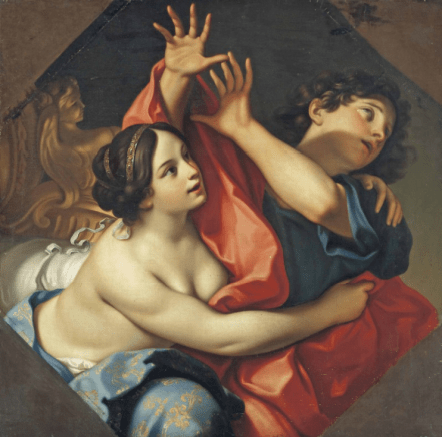
“Joseph and Potiphar’s Wife”, Carlo Cignani (Italian, 1628 – 1719)
We will finish Book VI of Confessions, where Augustine deals with issues of the pursuit of truth, his struggles with lust, the afterlife, and final judgment.
UPDATE: “Confessions” – Book IV: Chapters 1 – 8

St. Augustine of Hippo is depicted in a stained-glass window in Crosier House in Phoenix.
Today, we discussed whether or not the Bible allows co-habitation between couples, especially among Christians (as is most often the case, theology/religion cannot compete with personal sexual desires and urges – physical desires will almost always win); the theology of death; and then whether or not we can be “friends” with God.
Our essays are here.
“Confessions” – Book IV: Chapters 1 – 8
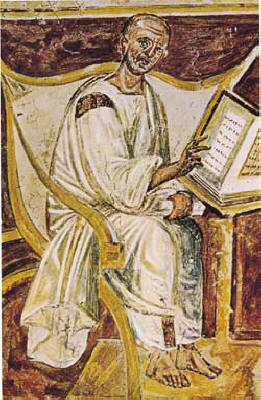
The earliest known portrait of Saint Augustine in a 6th-century fresco, Lateran, Rome
At the start of this book, Augustine had returned home to Thagaste only to be kicked out by his mother for his Manichaen beliefs and less so for his mistress. However, he was able to launch his career as a professor of rhetoric due to his patron, Romanianus, who had provided liberally towards his education. Augustine would stay with him after his mother had kicked him out.
Questions for ‘Confessions’ Book I: Chapters 1 – 10

Don’t let this baby’s unbearable cuteness deceive you. She’s a helpless, natural born sinner according to Augustine.
Hi everyone, we will be covering Book I, chapters 1 – 10.
Augustine titled his deeply philosophical and theological autobiography Confessions to implicate two aspects of the form the work would take. To ‘confess’, in Augustine’s time, meant both to give an account of one’s faults to God and to praise God or to speak one’s love for God. These two aims come together in the Confessions in an elegant but complex sense: Augustine narrates his ascent from sinfulness to faithfulness not simply for the practical edification of his readers, but also because he believes that his narrative itself is really a story about God’s greatness and of the fundamental love all things have for Him. Thus, in the Confessions form equals content to a large degree—the natural form for Augustine’s story of redemption to take would be a direct address to God, since it is God who must be thanked for such redemption. (That said, a direct address to God was a highly original form for Augustine to have used at the time).
 Project Augustine