Home » Posts tagged 'Christianity' (Page 4)
Tag Archives: Christianity
Chapter 21: Enlightenment: Ally or Enemy? (1492 – 1815) – Part II (1650 – 1750)
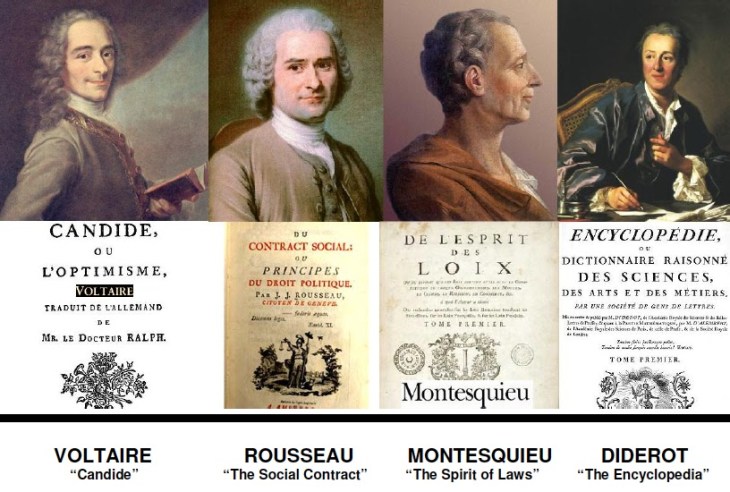
For our next meeting on Tuesday, August 26, please read the next three sections of Chapter 21: Social Watersheds in the Netherlands and England (1650 – 1750), Gender Roles in the Enlightenment, and Enlightenment in the Eighteenth Century.
UPDATE – Chapter 21: Enlightenment: Ally or Enemy? (1492 – 1815) – Part I (1492 – 1700)

Benoît Louis Prévost, An engraving from the 1772 edition of the “Encyclopédie”. Truth, in the top center, is surrounded by light and unveiled by the figures to the right, Philosophy and Reason.
Today we delve into the first part of a series of studies on the Age of Enlightenment and its effects on Christianity.
Here, we delve into challenges to the authority of the Church and the Bible, the philosophy of Baruch de Spinoza, and the aftermath that the 1492 Expulsion of the Jews in Spain and Portugal had in fostering religious skepticism and doubt.
Chapter 21: Enlightenment: Ally or Enemy? (1492 – 1815) – Part I

“A Philosopher lecturing with a Mechanical Planetary” by Joseph Wright, 1766
We will be having our next meeting on Tuesday, August 12.
Please read the first two sections of Chapter 21: Natural and Unnatural Philosophy (1492 – 1700) and Judaism, Skepticism, Deism (1492 – 1700), and please answer one of the following questions:
- What are the origins and purposes of Freemasonry or Masonic practice? What attitudes of the Reformation did they inherit? What connections did they have with more esoteric sources of sacred literature like hermetic books, Neoplatonic writings, and the Jewish Cabbala?
- Describe the impact of the Scientific Revolution of the 16th and 17th centuries. How did the study and progress of science (or ‘natural philosophy’) impact theology during this time? What were some of the religious ideas of Sir Isaac Newton? What was the primary focus of Francis Bacon’s project in extending human knowledge through empiricism and how did it relate to the story of Adam and Eve?
- Describe the impact the 1492 expulsion of the Jewish population in the Iberian peninsula had upon Europe as they spread to other territories. How did they view the Reformation? How did the culture of doubt and skepticism of religion come about as a result of oppressive Church practices like the Iberian Inquisitions? How did the religiously tolerant atmosphere of places like Amsterdam foster religious skepticism?
- Discuss the impact of the thoughts and works of Baruch de Spinoza. What were some of his beliefs about God and religion that many found so dangerous? Describe his two important works Tractatus Theologico-Politicus (1670) and Ethics (1677). Why were these works banned?
- Discuss how the Huguenots were behind many of the anti-religious writings during the Enlightenment. Explain how the historical criticism of the Bible during this time led to serious doubts about its divine inspiration.
- How did the observations of Pierre Bayle, Thomas Hobbes, early Quakers, Isaac La Peyrere, and the discovery of other races of people in the Americas affect thought about the authority of the Church and the authority of the Bible?
- What is deism and how did it gain prominence during the Enlightenment? How did Protestant Evangelicals and Pietist counteract deism?
I know some are really excited to read this part of history and the importance of the Enlightenment, so it should be fertile ground for some interesting discussions and insights in the upcoming weeks ahead. Really looking forward to our discussions.
Please submit your essays by Monday, August 11.
What is God Like? Does God Change? Is Everything Predetermined/Predestined by God? Has God Settled the Future? – Greg Boyd
Does God change?
Does God know the future?
In most churches today, if you would answer in the affirmative to the first question and negative to the second, you’d likely be branded a heretic or “liberal”. Many people seem to be so set in his or her ways that they won’t even carefully consider a different opinion or viewpoint about God or other theological matters. But it makes sense – for many, his or her view of God that they’ve grown up with or have adopted over the years, they’ve formed a close, emotional (not just psychological or spiritual) bond to it that’s hard to let go.
The very notion of entertaining the thought of God NOT knowing the future or that he can experience new things, or that he is NOT in absolute, complete control of everything (his omniscience, omnipotence, etc.) can be quite (emotionally) unsettling to even consider. (As a criticism of open theism, it may seem to anthropomorphize God a bit too much.)
Much of theology these days (and same goes to a vast majority of the view of God that is communicated through pulpits every week on any given Sunday) seem to be stuck in medieval or Reformation times, and seem to be unwilling to budge. As you know, much of history, science, technology, etc. has changed and progressed since that time, and the Church has had a hard time (or a very stubborn reluctance in) catching up to the rapid changes that are happening in our modern world, so it faces a crisis of remaining relevant to future generations if the Church continues on this trend I believe.
Perhaps our theology and understanding of God need to be updated.
Interesting viewpoints on God’s nature and action according to open theism.
From the website:
Does God know all future events? Only if the future is in some real sense already determined. God, to be God, must know every true proposition, including all about the future. But if the future is truly ‘open’, not even God could know the future because there are no true facts about the future to know. Why is this disturbing?
Has God Settled the Future? – Greg Boyd
Gregory A. Boyd’s profile and an interesting series on God and theology below his profile.
The Hidden Agenda Behind the NIV Bible

NIV- An unreliable translation of the Bible?
I was exposed to how prone to error the NIV translation of the Bible was in the past, but not to this extent!
(I myself prefer the NASB, NRSV, or the ESV versions of the Bible. The only times I read or encounter the NIV these days are Sundays at church.)
The NIV is arguably the most popular translation of the Bible in America, or at least one of the most popular throughout the world. Therefore, could millions of Christians over the years been misled in our understanding of the Bible by the NIV translators?
Lots of times, we want the Bible (or even God for that matter) to fit into our own image and conform to our view of the world or reality, and not the other way around. It seems as if those who came up with the NIV seem to have placed the conservative evangelical doctrine of the infallibility and inerrancy of Scripture front and foremost, and let that be the driving motivation behind the translation, which then leads to gross misinterpretations and even erroneous belief systems.
UPDATE: Chapter 18 – Rome’s Renewal (1500 – 1700) – Witch Hunts, Huguenots, Teresa of Avila, and John of the Cross
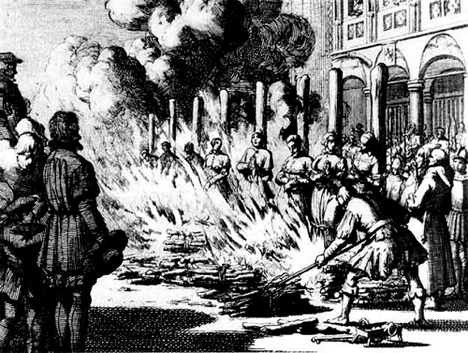
Women burned after being accused of witchcraft in Europe during the 1500s – 1700s.
Had another interesting session once again tonight.
Here are our submissions.
Ron dropped by and offered some interesting perspectives on the history of the Church in general. Many Protestants today criticize the Catholic Church for abuses of power throughout history, marginalizing others and succumbing to greed and accusing others of heresies; however, Protestants as we have seen are not immune at all as well and have succumbed to these vices just as much, if not more.
John Calvin – Video Lecture by Prof. Tony Lane – Part 1
Video lecture by Prof. Tony Lane, Professor of Historical Theology, London School of Theology on John Calvin.
Presented by St. John’s Nottingham.
A Critical Assessment of the Reformed Doctrines of Original Sin and Solus Christus (Salvation in Christ Alone)

So yesterday, we had an interesting discussion on the doctrines of Solus Christus (Salvation in Christ Alone) and Original Sin.
I just want to make this clear that these critical assessments of these core Reformed doctrines are in no way to undermine or question the validity of the Christian faith. We raise these issues and challenges to strengthen the faith and understand what Christians actually believe in.
However, I understand how emotionally involved persons who have adopted these traditions and doctrines to heart are and who take this personally. And I’m fully aware how nasty debates can become, even between faithful brothers and sisters in Christ. We do it because we take the truth seriously. We don’t want to engage in polemics attacking or pushing someone to adopt or reject another point of view. Its purpose is to raise thoughtful questions and engage and spur others to think things through.
We live in a complex and interconnected world today and many worldviews will come into contact with one another. It is important to take other viewpoints into consideration and call out those that do not make sense, are flatly wrong, or seem antiquated.
We raise questions, not to cause people to doubt their faith, but more so to realize that an unexamined faith is not worth believing in (to modify Socrates’ famous quote that “An unexamined life is not worth living”).
We welcome thoughtful discussion and disagreements with the ideas and viewpoints we present here, so please do comment if you wish.
This is theology in action – faith seeking understanding.
Predestination/Election – A Biblical Perspective

What does this mean? Is this interpretation even in the Bible?
Since the group will be encountering John Calvin very soon in MacCulloch’s book, I thought I’d get a head start and write about one of the most famous and also controversial doctrines of the Protestant/Reformed theology – predestination or election.
It’s definitely a hot potato topic and if you want to rile up a bunch of Christians and see some heated conversations, just introduce the topic of predestination, sit back, enjoy, and watch the sparks fly.
Well, here’s my entry into this eternal theological boxing ring for all its worth.
Also, as you’ll see, it’s listed on a new sub-menu called “Reformed Theology” under “Theology” at the top menu bar.
Though I know what I present won’t be a novel position by any means, it did give me pause to think when I first read it in Eugene Boring and Fred Cradock’s The People’s New Testament Commentary (Westminster John Knox Press, 2004).
I’d love to hear your thoughts about this topic as well, so please do share if you have any.
 Project Augustine