Home » Posts tagged 'Christianity' (Page 3)
Tag Archives: Christianity
“Confessions” – Book VII – Chapters 1 – 10

“Lucifer, the Fallen Angel” by Gustave Dore (1832 – 1883)
Before mentioning the questions, please read Michael’s submission from last session here at the end.
We will begin Book VII: Chapters 1 – 10 of Confessions.
Although Augustine has been using Neoplatonic terms and ideas throughout the Confessions it’s here in Book VII that he reaches the point when he first reads Neoplatonic philosophy. This is a pivitol moment for the young Augustine, who finds in Neoplatonism a way of reconciling his long pursuit of philosophy with his new and serious faith in Christianity. The union of this philosophy and this theology will guide his work (including the Confessions) for the rest of his life.
UPDATE: “Confessions: Book VI – Chapters 9 – 16

Saint Augustine, detail from the Doctors of the Church Cycle, 1487-1492, fresco, Church of the Santissima Annunziata, Franciscan Monastery, Cortemaggiore, Emilia-Romagna. Italy, 15th century.
We conclude Book VI of “Confessions” with essays on self-interest vs. public interest in political offices, the role of the Church and her teachings on premarital sex, and thoughts on universal salvation and a glimpse into the true cost of forgiveness and grace.
Read them here.
Confessions: Book VI – Chapters 9 – 16
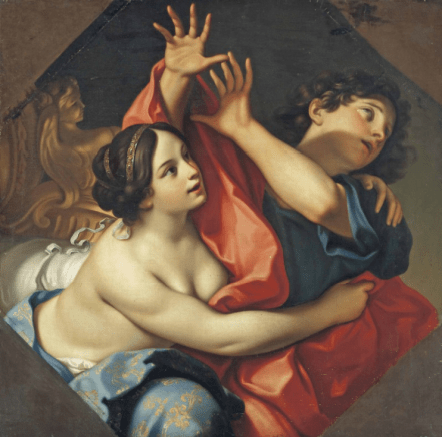
“Joseph and Potiphar’s Wife”, Carlo Cignani (Italian, 1628 – 1719)
We will finish Book VI of Confessions, where Augustine deals with issues of the pursuit of truth, his struggles with lust, the afterlife, and final judgment.
UPDATE: “Confessions”: Book VI – Chapters 1 – 8

Here are our essays for Book VI: Chapters 1 – 8, where we discuss about materialism and happiness, and on the culture of anti-intellectualism in American churches in general and what it means to love God with all your mind.
“Confessions” Book V: Chapters 8 – 13

Augustine and Monica sit listening to a sermon from Bishop Ambrose in a painting by Ambrogio il Bergognone (1455 – 1535), Turin, Italy
Yes, we’re back from a month long hiatus. We will finish Book V of Augustine’s Confessions.
In 383, at the age of 29, Augustine sailed from Carthage with his partner and their son, along with his two close friends Alypius and Nebridius, to Rome for a teaching position where he hoped to engage with better behaved students. By that time, Rome was no longer the center of the western empire; the emperor resided in Milan.
The next year, after winning a competition for a post as public teacher of rhetoric, he moved to Milan. It was there that he first encountered the formidable figure of Ambrose the bishop of Milan. He was to have a profound influence on Augustine’s life and thought.
Confessions: Book V – Chapters 1 – 7

Uyghur Manichaean clergymen, wall painting from the Khocho ruins, 10th/11th century AD. Located in the Museum für Indische Kunst, Berlin-Dahlem.
Book V follows the young Augustine (he was around 29 years old at this time) from Carthage (where he finds his students too rowdy for his liking) to Rome (where he finds them too corrupt) and on to Milan, where he will remain until his conversion.
He spends most of the first half of this book recounting his encounter with Faustus, a Manichee luminary.
Please write on one of the following topics:
UPDATE: “Confessions”: Book III – Chapters 7 – 12

What do we mean when we say that God is ‘Spirit’? What is a ‘spirit’ anyway? How is it different from a soul? How do we relate with God’s spirit? Or is ‘spirit’ just a fancy way of saying ‘I have no clue what I’m talking about’?
So we had a very active and stimulating meeting last night and discussed a whole range of topics; a lot of it focused on the nature of God and how He relates with us.
Virtually all of us agreed that a theocracy was not the best form of government and disagreed that the Kingdom of God that Jesus talked about would not fall under the category of a theocracy; strains of Manichean beliefs or at least dualism within not only charismatic and fundamentalist sects of Christianity but also Catholicism; struggling to define what a ‘spirit’ actually is and what it means that God is ‘spirit’, and whether or not it differs with the concept of a soul; the eternal question of free will and God’s sovereignty (i.e. Does God have a predetermined plan for everyone’s lives or are we responsible for our own actions) and whether or not the universe might be free and open; and discussions on whether or not God suffers and if that is the case, does that mean He can change his mind or plan on things.
Here are our essays.
UPDATE: Final Thoughts on Diarmaid MacCulloch’s “Christianity: The First Three Thousand Years”
Well, we’ve come to the end after two years of reading “Christianity: The First Three Thousand Years” and we share our final thoughts here.
Howard and Chris share what they have learned and gained from reading this book; Michael writes about the historical development of how Greek pagan philosophy seeped into Western theology and how it has affected our contemporary reading of the Bible; I share my thoughts on divine intervention (or non-intervention more specifically) and history or my attempt to understand God’s role in history after having read this book.
We hope and pray that we will use the knowledge gained from this session wisely. I believe that this is just the beginning of our journey into learning more about the history of the Church.
Final Thoughts on “Christianity: The First Three Thousand Years” by Diarmaid MacCulloch

After a long hiatus, we will share our final thoughts on MacCulloch’s book.
Please write a summary of these main points:
- Go back to your very first essays here to see if reading this book fulfilled some or all of your expectations. What were the strengths and weaknesses of this book in relation to your expectations from the start?
- Provide one (no more than two if need be) area or moment of Church history as told by MacCulloch that was most interesting for you or changed your perspective of Christianity.
- Finally, how has your faith been affected after having read through Church history? What lingering questions or thoughts do you still have?
We will have our final meeting on Christianity: The First Three Thousand Years next Sunday, May 3.
Chapter 21: Enlightenment: Ally or Enemy? (1492 – 1815) – Part III – The French Revolution and its Aftermath

“Liberty Leading the People”, Eugene Delacroix, 1830 It commemorated the July Revolution of 1830 which toppled King Charles X of France. A woman personifying Liberty leads the people forward over the bodies of the fallen, holding the flag of the French Revolution – the tricolor flag which is still France’s flag today.
For our next meeting, we will be concluding our survey of the Enlightenment period by reading the last two sections of Chapter 21: The French Revolution (1789 – 1815) and Aftermath of Revolution: A Europe of Nation-States.
We’ve come a long way in our study of Christian history. Starting with the seeds of Western Civilization in ancient Greece, to the humble beginnings of the ministry of Jesus of Nazareth, the growth of the Church in Roman times, through the Middle Ages, the rise of the Catholic Church and the Christian Empire, the spread of Orthodox Christianity, the impact of the Reformation, the spread of Christianity throughout the entire world in Europe, Africa, Russia, Asia, and to North and South Americas, and now we come into the origins of the modern world we live in today starting with the Enlightenment period. Christianity and her Church have come a long way and have been through much change to say the very least.
 Project Augustine