Home » Posts tagged 'Christian theology' (Page 3)
Tag Archives: Christian theology
“Confessions” – Book VII – Chapters 1 – 10

“Lucifer, the Fallen Angel” by Gustave Dore (1832 – 1883)
Before mentioning the questions, please read Michael’s submission from last session here at the end.
We will begin Book VII: Chapters 1 – 10 of Confessions.
Although Augustine has been using Neoplatonic terms and ideas throughout the Confessions it’s here in Book VII that he reaches the point when he first reads Neoplatonic philosophy. This is a pivitol moment for the young Augustine, who finds in Neoplatonism a way of reconciling his long pursuit of philosophy with his new and serious faith in Christianity. The union of this philosophy and this theology will guide his work (including the Confessions) for the rest of his life.
UPDATE: “Confessions: Book VI – Chapters 9 – 16

Saint Augustine, detail from the Doctors of the Church Cycle, 1487-1492, fresco, Church of the Santissima Annunziata, Franciscan Monastery, Cortemaggiore, Emilia-Romagna. Italy, 15th century.
We conclude Book VI of “Confessions” with essays on self-interest vs. public interest in political offices, the role of the Church and her teachings on premarital sex, and thoughts on universal salvation and a glimpse into the true cost of forgiveness and grace.
Read them here.
Confessions: Book VI – Chapters 9 – 16
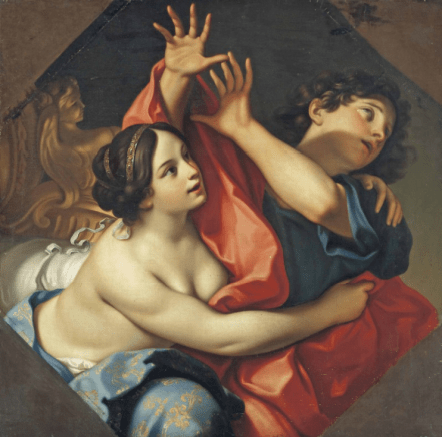
“Joseph and Potiphar’s Wife”, Carlo Cignani (Italian, 1628 – 1719)
We will finish Book VI of Confessions, where Augustine deals with issues of the pursuit of truth, his struggles with lust, the afterlife, and final judgment.
Confessions: Book V – Chapters 1 – 7

Uyghur Manichaean clergymen, wall painting from the Khocho ruins, 10th/11th century AD. Located in the Museum für Indische Kunst, Berlin-Dahlem.
Book V follows the young Augustine (he was around 29 years old at this time) from Carthage (where he finds his students too rowdy for his liking) to Rome (where he finds them too corrupt) and on to Milan, where he will remain until his conversion.
He spends most of the first half of this book recounting his encounter with Faustus, a Manichee luminary.
Please write on one of the following topics:
UPDATE: “Confessions” – Book IV: Chapters 1 – 8

St. Augustine of Hippo is depicted in a stained-glass window in Crosier House in Phoenix.
Today, we discussed whether or not the Bible allows co-habitation between couples, especially among Christians (as is most often the case, theology/religion cannot compete with personal sexual desires and urges – physical desires will almost always win); the theology of death; and then whether or not we can be “friends” with God.
Our essays are here.
“Confessions” – Book IV: Chapters 1 – 8
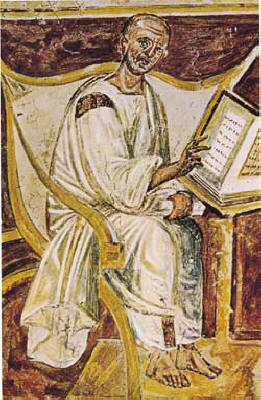
The earliest known portrait of Saint Augustine in a 6th-century fresco, Lateran, Rome
At the start of this book, Augustine had returned home to Thagaste only to be kicked out by his mother for his Manichaen beliefs and less so for his mistress. However, he was able to launch his career as a professor of rhetoric due to his patron, Romanianus, who had provided liberally towards his education. Augustine would stay with him after his mother had kicked him out.
UPDATE: “Confessions”: Book III – Chapters 7 – 12

What do we mean when we say that God is ‘Spirit’? What is a ‘spirit’ anyway? How is it different from a soul? How do we relate with God’s spirit? Or is ‘spirit’ just a fancy way of saying ‘I have no clue what I’m talking about’?
So we had a very active and stimulating meeting last night and discussed a whole range of topics; a lot of it focused on the nature of God and how He relates with us.
Virtually all of us agreed that a theocracy was not the best form of government and disagreed that the Kingdom of God that Jesus talked about would not fall under the category of a theocracy; strains of Manichean beliefs or at least dualism within not only charismatic and fundamentalist sects of Christianity but also Catholicism; struggling to define what a ‘spirit’ actually is and what it means that God is ‘spirit’, and whether or not it differs with the concept of a soul; the eternal question of free will and God’s sovereignty (i.e. Does God have a predetermined plan for everyone’s lives or are we responsible for our own actions) and whether or not the universe might be free and open; and discussions on whether or not God suffers and if that is the case, does that mean He can change his mind or plan on things.
Here are our essays.
“Confessions” – Book III: Chapters 7 – 12

Saints Augustine and Monica, 1854. Artist: Scheffer, Ary (1795-1858)
We will finish the rest of Book III as we go over chapters 7 – 12.
The more questions I think of as I go through Confessions the more profoundly impressed I am of Augustine and his thinking.
Please answer one of these questions and write an essay on it.
UPDATE: “Confessions” Book I, Chapters 11 – 20

Orthodox icon of St. Augustine – the patron saint of theologians
Here are our responses from last week on Augustine’s Confessions: Book I, Chapters 11 – 20.
We investigated Augustine’s thoughts on the relationship between the human condition and sin; baptism; mankind’s desire for wealth and fame; and his criticisms of educational institutions.
Plotinus and Neo-Platonism’s Influence on Augustine

Plotinus (205 – 270)
Before we delve into Confessions, we will start exploring the development of Augustine’s philosophy and theology.
For a while, Augustine had been influenced by Manichaeism, a Persian adaptation of Christianity, which added in Zoroastrianism, speculative philosophy and superstition. Augustine was a Manichee for nine years. Then during a trip to Rome in 383, due to his education in the liberal arts, he began to question Manichaeism when he saw that its understanding of the universe owed more to astrology than astronomy.
The next year, he met the formidable figure of Ambrose, bishop of Milan. His great intellect and fiery sermons left a deep impression on Augustine. In Ambrose, Augustine found someone who could communicate at his own intellectual level, further confirming his rejection of the Manichees and opening the way for his return to the Christian faith.
 Project Augustine