Home » Posts tagged 'Christian philosophy' (Page 2)
Tag Archives: Christian philosophy
“Confessions” – Book IV: Chapters 1 – 8
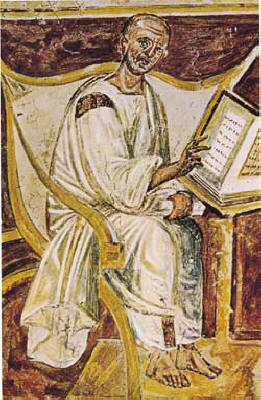
The earliest known portrait of Saint Augustine in a 6th-century fresco, Lateran, Rome
At the start of this book, Augustine had returned home to Thagaste only to be kicked out by his mother for his Manichaen beliefs and less so for his mistress. However, he was able to launch his career as a professor of rhetoric due to his patron, Romanianus, who had provided liberally towards his education. Augustine would stay with him after his mother had kicked him out.
UPDATE: “Confessions”: Book III – Chapters 7 – 12

What do we mean when we say that God is ‘Spirit’? What is a ‘spirit’ anyway? How is it different from a soul? How do we relate with God’s spirit? Or is ‘spirit’ just a fancy way of saying ‘I have no clue what I’m talking about’?
So we had a very active and stimulating meeting last night and discussed a whole range of topics; a lot of it focused on the nature of God and how He relates with us.
Virtually all of us agreed that a theocracy was not the best form of government and disagreed that the Kingdom of God that Jesus talked about would not fall under the category of a theocracy; strains of Manichean beliefs or at least dualism within not only charismatic and fundamentalist sects of Christianity but also Catholicism; struggling to define what a ‘spirit’ actually is and what it means that God is ‘spirit’, and whether or not it differs with the concept of a soul; the eternal question of free will and God’s sovereignty (i.e. Does God have a predetermined plan for everyone’s lives or are we responsible for our own actions) and whether or not the universe might be free and open; and discussions on whether or not God suffers and if that is the case, does that mean He can change his mind or plan on things.
Here are our essays.
“Confessions” – Book III: Chapters 7 – 12

Saints Augustine and Monica, 1854. Artist: Scheffer, Ary (1795-1858)
We will finish the rest of Book III as we go over chapters 7 – 12.
The more questions I think of as I go through Confessions the more profoundly impressed I am of Augustine and his thinking.
Please answer one of these questions and write an essay on it.
Plotinus and the Immortality of the Soul

It’s been a while since I last posted here, but we’re ready to kick things off with our new semester.
As stated, before heading straight into Augustine’s Confessions it is highly beneficial to understand where Augustine is coming from. Before coming to the Christian faith, he was heavily influenced by the philosophy of Plotinus and Neo-Platonism. You’ll find echoes of Plotinus and Neo-Platonism laced throughout Confessions.
Plotinus and Neo-Platonism’s Influence on Augustine

Plotinus (205 – 270)
Before we delve into Confessions, we will start exploring the development of Augustine’s philosophy and theology.
For a while, Augustine had been influenced by Manichaeism, a Persian adaptation of Christianity, which added in Zoroastrianism, speculative philosophy and superstition. Augustine was a Manichee for nine years. Then during a trip to Rome in 383, due to his education in the liberal arts, he began to question Manichaeism when he saw that its understanding of the universe owed more to astrology than astronomy.
The next year, he met the formidable figure of Ambrose, bishop of Milan. His great intellect and fiery sermons left a deep impression on Augustine. In Ambrose, Augustine found someone who could communicate at his own intellectual level, further confirming his rejection of the Manichees and opening the way for his return to the Christian faith.
Brief Overview of St. Augustine’s Philosophy
I know that I stated that we’d be doing Augustine’s Confessions later on this month, but I’ve decided to hold off a bit longer to see if we can recruit some more people into the group, so we will not begin until June.
In the meantime, we will spend the rest of the month getting to know Augustine and the world he lived in better.
The video above gives an overview of Augustine’s philosophy and the world he lived in, which is vital to understand what and why he wrote. Although much of the video focuses on his monumental The City of God, we still get a good general overall sense of his beliefs, especially his political philosophy, and why he is still relevant today.
Does God Change in Response to Suffering? Motlmann, von Speyr, the Cross, and the Suffering of God, the Trinity

Matthias Grünewald, Isenheim Altarpiece, chapel of the Hospital of Saint Anthony, Isenheim, Germany, c. 1510-15, oil on wood
Undoubtedly, suffering and death changes us in some degree or another. It’s a given in life. A death of a close friend, parent, or loved one can profoundly affect the outlook of one’s life.
I can only imagine the unimaginable pain a parent has to go through if their child dies. It would undoubtedly change the parent’s life.
Is it the same for God then? Did God change when he experienced Jesus’ death? Does God himself change in response to suffering, pain, and death?
Plato and Theology
In order to really get a good understanding of Christian theology and Christian philosophy, you first need a solid foundation of understanding Plato’s philosophy.
There’s just no way around it. Even Paul’s writings contain Platonic thought and ideas.
Plato’s philosophy still heavily influences Christianity today as well – for instance, our ideas about body/soul dualism, the afterlife, the spiritual being greater than the flesh/material, repentance, conversion, etc.
Here are some summaries we wrote about Plato’s and Greek philosophy’s impact on Christian thought here in terms of church history.
Here is Prof. Andrew Davison of St. Johns College, Nottingham, UK, talking about how Plato influenced Christian philosophy – especially that of Augustine, who was heavily influenced by Plotinus and Neoplatonism.
 Project Augustine