Home » Posts tagged 'Augustine of Hippo' (Page 3)
Tag Archives: Augustine of Hippo
UPDATE: “Confessions” – Book IV: Chapters 1 – 8

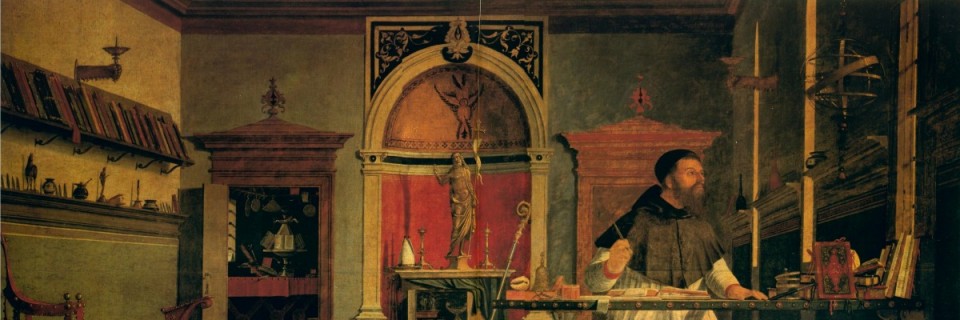
St. Augustine of Hippo is depicted in a stained-glass window in Crosier House in Phoenix.
Today, we discussed whether or not the Bible allows co-habitation between couples, especially among Christians (as is most often the case, theology/religion cannot compete with personal sexual desires and urges – physical desires will almost always win); the theology of death; and then whether or not we can be “friends” with God.
Our essays are here.
“Confessions” – Book IV: Chapters 1 – 8
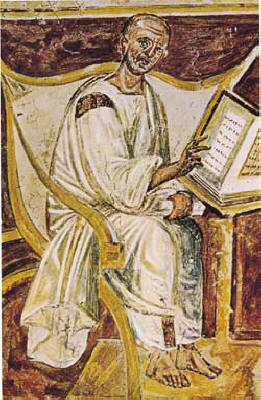
The earliest known portrait of Saint Augustine in a 6th-century fresco, Lateran, Rome
At the start of this book, Augustine had returned home to Thagaste only to be kicked out by his mother for his Manichaen beliefs and less so for his mistress. However, he was able to launch his career as a professor of rhetoric due to his patron, Romanianus, who had provided liberally towards his education. Augustine would stay with him after his mother had kicked him out.
UPDATE: “Confessions”: Book III – Chapters 7 – 12

What do we mean when we say that God is ‘Spirit’? What is a ‘spirit’ anyway? How is it different from a soul? How do we relate with God’s spirit? Or is ‘spirit’ just a fancy way of saying ‘I have no clue what I’m talking about’?
So we had a very active and stimulating meeting last night and discussed a whole range of topics; a lot of it focused on the nature of God and how He relates with us.
Virtually all of us agreed that a theocracy was not the best form of government and disagreed that the Kingdom of God that Jesus talked about would not fall under the category of a theocracy; strains of Manichean beliefs or at least dualism within not only charismatic and fundamentalist sects of Christianity but also Catholicism; struggling to define what a ‘spirit’ actually is and what it means that God is ‘spirit’, and whether or not it differs with the concept of a soul; the eternal question of free will and God’s sovereignty (i.e. Does God have a predetermined plan for everyone’s lives or are we responsible for our own actions) and whether or not the universe might be free and open; and discussions on whether or not God suffers and if that is the case, does that mean He can change his mind or plan on things.
Here are our essays.
“Confessions” – Book III: Chapters 7 – 12

Saints Augustine and Monica, 1854. Artist: Scheffer, Ary (1795-1858)
We will finish the rest of Book III as we go over chapters 7 – 12.
The more questions I think of as I go through Confessions the more profoundly impressed I am of Augustine and his thinking.
Please answer one of these questions and write an essay on it.
UPDATE: ‘Confessions’ Book III: Chapters 1 – 6
Here our our essays on Chapters 1 – 6 of Book III in Augustine’s Confessions.
This week, we tried to answer and explore the eternal philosophical question of “What is love?” as Haddaway expresses here.
Pretty lively discussions from our group this past muggy Thursday at Central Park.
Our essays focused on Augustine’s critique of theaters; try to answer what love is; experiences encountering the Bible; and the relationship between theology and philosophy.
‘Confessions’ – Book III: Chapters 1 – 6

The Mani Prayer wheel used for prayers in Tibetan Buddhism. Augustine was a follower of Manichaeism in his early life.
In Book III, Augustine leaves for Carthage from his hometown of Thagaste and enters a place and a lifestyle in which “all around me hissed a cauldron of illicit loves.” This is a low point in Augustine’s relationship with God–turned almost entirely toward transient diversions, he seems to feel he could get no lower.
It was during this time, when he was around sixteen years old, that he hooked up with a girl and would settle down with her for the next dozen years or so. In that time, having a common-law wife or living together and even having a child together was not considered particularly immoral. The main problem would be that she had come from a lower social class that Augustine which meant that any children they had would take her lower status, not his. This would cause problems for his family who most definitely wanted him to marry a woman with a high social standing. Augustine never reveals her name, most likely to protect her from unwanted attention. As Augustine would later write, she went back to Africa and vowed never to take another man.
UPDATE: “Confessions” Book I, Chapters 11 – 20

Orthodox icon of St. Augustine – the patron saint of theologians
Here are our responses from last week on Augustine’s Confessions: Book I, Chapters 11 – 20.
We investigated Augustine’s thoughts on the relationship between the human condition and sin; baptism; mankind’s desire for wealth and fame; and his criticisms of educational institutions.
Questions for ‘Confessions’ – Book I, Chapters 11 – 20

“The rich people of Rome had a great education. They were often schooled and were taught by their own private tutor, at home they would go to schools. The schools were boys only. All the learning was based from fear, The boys would be beaten for any offence. They did this because they figured if children fear getting the wrong answer they will get it correct. If a student were to get lots of answers wrong they would be held down and beaten with a leather strap. If you were poor chances are you would be able to read and write , but you would not be able to have your own tutor or be able to go to school. ” (source: https://historicalroots.wikispaces.com/Ancient+Romans) Augustine wrote about how he was beaten at school for bad performance. He writes, “I was still a boy when I first began to pray to you, my Help and Refuge. I used to prattle away to you, and though I was small, my devotion was great when I begged you not to let me be beaten at school. Sometimes, for my own good, you did not grant my prayer, and then my elders and even my parents, who certainly wished me no harm, would laugh at the beating I got – and in those days beatings were my one great bugbear.” (Confessions, Book I, Chapter 9)
In these chapters, Augustine describes his early education and what his childhood was like.
Here are some interesting facts about the time in which Augustine lived in that will provide some background information to clarify some historical details.
UPDATE: “Confessions” – Book I: Chapters 1 – 10

“St. Augustine Writing in His Cell”, Sandro Botticelli (1445 – 1510), Florence, Galleria degli Uffizi, c. 1490 – 94.
This past Thursday we had our first fruitful discussion of Augustine’s Confessions.
We had interesting discussions on topics about who makes the first step in reaching out to us: God or us? Musings on life and death (even reincarnation) and the ‘sinfulness’ of infants and babies were discussed.
You can take a look at our responses here.
Questions for ‘Confessions’ Book I: Chapters 1 – 10

Don’t let this baby’s unbearable cuteness deceive you. She’s a helpless, natural born sinner according to Augustine.
Hi everyone, we will be covering Book I, chapters 1 – 10.
Augustine titled his deeply philosophical and theological autobiography Confessions to implicate two aspects of the form the work would take. To ‘confess’, in Augustine’s time, meant both to give an account of one’s faults to God and to praise God or to speak one’s love for God. These two aims come together in the Confessions in an elegant but complex sense: Augustine narrates his ascent from sinfulness to faithfulness not simply for the practical edification of his readers, but also because he believes that his narrative itself is really a story about God’s greatness and of the fundamental love all things have for Him. Thus, in the Confessions form equals content to a large degree—the natural form for Augustine’s story of redemption to take would be a direct address to God, since it is God who must be thanked for such redemption. (That said, a direct address to God was a highly original form for Augustine to have used at the time).
 Project Augustine