Home » Theology (Page 8)
Category Archives: Theology
Does God Play Dice with the Universe? The Role of Chance and Providence in Theology and Science

“God does not play dice with the universe.”
– Albert Einstein
“Einstein, stop telling God what to do.”
– Niels Bohr, in reply to Einstein
In Gerald L. Schroeder’s book, The Science of God: The Convergence of Scientific and Biblical Wisdom, he describes the blind forces of nature that lie behind much of human grief:
“An earthquake shakes a bridge from its foundation, dropping it onto a crowded bus passing beneath. A chance cosmic ray smashes into an ovum, produces a free radical which in its natural drive to establish electrical balance tears and mutates a chromosome. As a result, a crippled child is born. The same Creator that produces the beauty of a sunrise and the colors of a flower must be credited with these horrors as well.” (p. 168)
Last year, while I was attending classes at a city college, I would always pass by a cerebral palsy center. From time to time, I would see patients from that center lined up outside, mostly in their motorized wheelchairs, waiting to be assisted upon by their caretakers or be helped unto a transport truck.
For some reason, thoughts and questions would run through my head each time I would see these patients –
What if I were them? What made me so special that I was born normal – even though my mother had a complicated pregnancy with me, I came out relatively normal? But what about these patients afflicted with cerebral palsy? Was God directly involved in contributing to their physical and mental conditions? Or was it by pure, random chance, with no discernible reason whatsoever that they were in the condition that they were in? Didn’t God have the power to divert the cosmic ray from hitting the ovum and mutating the chromosome perhaps? Did he do that for me? Why me then and why them?
Or perhaps there’s just no reason or purpose whatsoever in all this.
It was by pure random, blind chance that I was born this way and not another.
And you can run a billion what-if scenarios in your head and ruminate what your life would’ve been like if you made this decision or that, etc.
Did we even have a choice to begin with?
Neuroscience of Memory and Salvation (Soteriology)

Memory-forming molecules traveling around the brain to form new memories.
Came upon this site about the latest research on how memory forms in the brain.
This relates to some articles I wrote about pertaining to cognitive neuroscience and theology. (The summaries on Peterson and Rev. Choong in particular.)
The key point to understand is that when memory forms, or when new memories form in your brain or when you learn something new (like I hope you’re doing now), there’s a physical change that’s occurring in your brain – i.e. your brain changes.
Through the Wormhole: Did We Invent God?
Through the Wormhole with Morgan Freeman is one of my favorite series to watch on tv that’s on the Science Channel.
From time to time, they’ll show episodes concerning God and science.
This episode explores the latest research done in psychology and neuroscience about where the origins of human belief in the supernatural may have come from.
This episode poses interesting questions, such as:
- Does God only exist in our minds?
- Is a belief in God “hardwired” within us?
- What is required to believe in a God or supernatural entity? Can animals believe or sense the divine? (i.e. at the bare minimum you need a theory of mind as far as we can tell.)
- Is belief in God just a remnant from our evolutionary past to explain what’s going on in our world?
- Is it just childish superstition that we haven’t outgrown?
- Did God create us? Or did we create God?
New Submissions for Chapter 13: “Hagia Sophia” & “Byzantine Spirituality”
Hi all,
New updates and submissions about the reign of Justinian I (aka Justinian the Great), the Byzantine Empire, Hagia Sophia, and the Orthodox theology of theosis. You can find them here.
Tonight, there were interesting talks about what constitutes theosis and how it perhaps relates to the more Reformed understanding of sanctification.
Also, to clarify some points on terminologies that often confused us tonight:
- Dyophysitism – the Chalcedonian position that full deity and full humanity exist in the person of Jesus Christ as two natures without confusion or change.
- Monophysitism – states that in the person of Jesus Christ, his human nature was absorbed into the divine nature like a cube of sugar dissolves in a cup of water. Therefore, Christ was left with only one nature, the Divine (Greek mono- one, physis – nature). (i.e. Christ had only a Divine nature.)
- Miaphysitism – holds that in the one person of Jesus Christ, his Divinity and Humanity are united in one “nature” (physis), the two being united without separation, without confusion, and without alteration. This is the position of the Orthodox and Coptic Churches.
It was also interesting to see tonight how hard it is for most Christians to articulate very basic terminologies we use all the time like:
- What is a spirit? How is it different from the soul? What is a soul anyway? After death, how exactly does the soul or the spirit separate from the body?
- How is a soul saved by God? Saved from what ? It’s saved from Hell? What is hell exactly and where exactly is it located within the known universe? If it’s outside the universe, how do know that? (Same questions apply to the notion/concept of heaven.)
- What is the nature of a “resurrected” or “spiritual” body? What type of matter will it consist of?
Chapter 13: Faith in a New Rome (451 – 900) – Part 1
Hello folks and Happy New Year!
We’ve definitely come a long way since we first embarked on this book last year and hopefully garnered much since then – let’s keep the momentum going throughout this year.
For our next meeting on Thursday, Jan. 9, we’ll cover the first two sections of Chapter 13 that deals with the Byzantine Empire and the Orthodox Church: “A Church to Shape Orthodoxy: Hagia Sophia” and “Byzantine Spirituality: Maximus and the Mystical Tradition”.
We’ll spend the next couple of months dealing with the Orthodox Church that will hopefully lift the veil of obscurity that most evangelical and Western Christians have of it.

Why study Thomas Aquinas?
In Chapter 12 of Prof. MacCulloch’s book, he went over one of the great “doctors” of the Catholic Church, St. Thomas Aquinas.
In this clip, Dr.Simon Oliver from the University of Nottingham discusses why he devotes so much attention to the medieval Dominican theologian, Thomas Aquinas (1225-74); he argues that when someone today comes to grips with his thought, that learning experience trains one to think theologically.
Also added a link to the “Resources” Page for the University of Nottingham’s youtube channel. Great talks with professors about Christian theology, philosophy, church history, and religion.
Update: New Menu and sub-menu topic added – Cognitive Neuroscience and Theology

Just created several new pages pertaining to current studies within Cognitive Neuroscience and Theology under the new menu category Science and Theology on top.
Some topics of interest include:
- free will; how human emotions affect our decisions
- biblical understanding of the afterlife
- is there an intermediate state after death?
- do our identities survive after death? If so, then how?
- what the Apostle Paul believed about the afterlife
- eschatological ontology
- role of genetics and environmental influences upon the brain in relation with human free will
- consciousness and the soul; do we even have a soul?
- the selective and fluid nature of memory; false memories
- Why are there so many factual discrepancies in the gospel narratives and accounts in the New Testament?
Check out the new page here.
New Update: Chapter 12: A Church for All People? (1100 – 1300)
New updates here for Chapter 12. Please read our submissions.
We will be on break until January.
“Do Infants Go to Hell if They Die Before Baptism?: The Doctrine of Original Sin Re-examined” – an Orthodox Perspective
We will be covering the Orthodox Church very soon in MacCulloch’s book, so it’s good to get a glimpse of a bit of its theology and how it differs from the West, especially when it comes to the definition of “sin”.
“It is not clear by what justice humanity can share in Adam’s guilt when it existed only in potentiality in his loins at the time of the Fall. It is also difficult to see why the children of the baptized should inherit a guilt from which their parents have been cleansed.” – Prof. Gerald Bonner, Roman Catholic theologian
It’s good to bear in mind that Augustine never intended his theology of “Original Sin” to be a world-wide, eternal church doctrine – it was the Church many years later that adopted this idea and made it into a doctrine. Later on, Protestantism adopted this as doctrine as well and has shaped Western theology ever since.
It’s amazing how a mis-reading of the Bible that led to a mis-interpretation that led to this doctrine. This is why it’s always critical to have good exegesis precede hermeneutics.

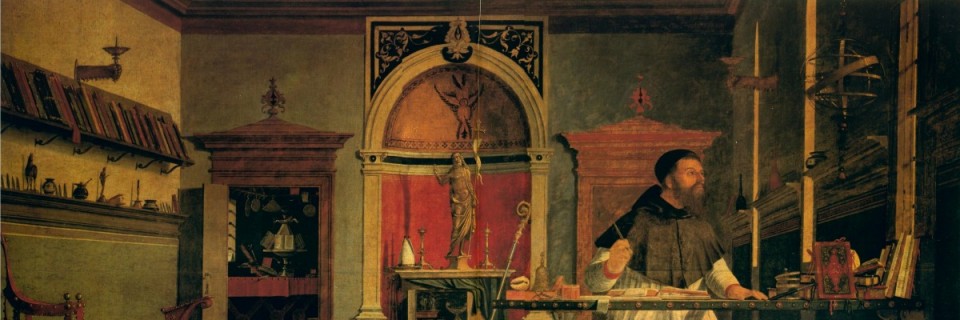
 Project Augustine