Home » Theology (Page 3)
Category Archives: Theology
UPDATE: “Confessions” – Book V: Chapters 8 – 13

We had our first meeting back from over a month this past Sunday. We were a bit rusty in the beginning but we quickly picked up from right where we were before.
We went over Book V: Chapters 8 – 13 of Augustine’s “Confessions.” We discussed about whether or not we should read the Bible literally, if Christianity is meaningless without an afterlife, the role of doubt and skepticism in matters of faith, whether or not your sincerity and way of living affects answers to prayer, how we “picture” God when we pray, and whether or not the concept or reality of evil has relevance only in human terms.
You can find our essays here.
“Confessions” Book V: Chapters 8 – 13

Augustine and Monica sit listening to a sermon from Bishop Ambrose in a painting by Ambrogio il Bergognone (1455 – 1535), Turin, Italy
Yes, we’re back from a month long hiatus. We will finish Book V of Augustine’s Confessions.
In 383, at the age of 29, Augustine sailed from Carthage with his partner and their son, along with his two close friends Alypius and Nebridius, to Rome for a teaching position where he hoped to engage with better behaved students. By that time, Rome was no longer the center of the western empire; the emperor resided in Milan.
The next year, after winning a competition for a post as public teacher of rhetoric, he moved to Milan. It was there that he first encountered the formidable figure of Ambrose the bishop of Milan. He was to have a profound influence on Augustine’s life and thought.
UPDATE: “Confessions” – Book V: Chapters 1 – 7

“Augustin Contre Faustus (Augustine Arguing with Faustus in the Presence of their Pupils)”, Bibliotheque Municipale, Avranches, France. The Ms 90 St. (c. 12th century).
Last night we went over our essays on Book V: Chapters 1 – 7 which you will find here. In these chapters, Augustine spends most of his time remembering his encounter with the preeminent Manichean scholar Faustus of Mileve and how it was through that meeting with him that eventually lead him away from Manichaeism.
We had an interesting discussion on the education (or lack of) in higher degrees for people in church leadership. We also discussed whether or not animals or creation in general can worship God, how science and religion could be reconciled, and how science can expose errors in theology.
I also came across an interesting article in The Wall Street Journal on a new book about St. Augustine by Robin Lane Fox titled Augustine: Conversions to Confessions that you can check out here.
Confessions: Book V – Chapters 1 – 7

Uyghur Manichaean clergymen, wall painting from the Khocho ruins, 10th/11th century AD. Located in the Museum für Indische Kunst, Berlin-Dahlem.
Book V follows the young Augustine (he was around 29 years old at this time) from Carthage (where he finds his students too rowdy for his liking) to Rome (where he finds them too corrupt) and on to Milan, where he will remain until his conversion.
He spends most of the first half of this book recounting his encounter with Faustus, a Manichee luminary.
Please write on one of the following topics:
UPDATE: “Confessions”: Book IV: Chapters 9 – 16
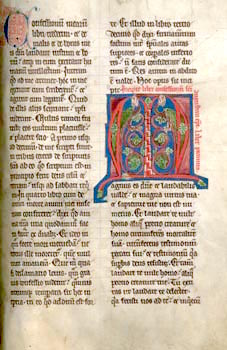
Augustine. Confessiones. BPH Ms 83. Manuscript on vellum. Germany, first half 13th century.
We have finished Book IV of Augustine’s Confessions.
We had discussions on excessive materialism, rampant anti-intellectualism within the Church, the nature of the knowledge of God, and experiences with God’s immanence.
Here are our essays on these topics.
“Confessions” – Book IV: Chapters 9 – 16

An olive tree that is believed to have been planted by Saint Augustine in Thagaste.
Yes, it’s been a while. But we’re still here and ready to go ahead.
We will continue with Book IV, Chapters 9 – 16.
In this book, returning to Thagaste from his studies at Carthage, Augustine began to teach rhetoric, making friends and chasing a career along the way. Though giving some account of these worldly matters, Augustine spends much of Book IV examining his conflicted state of mind during this period. Having begun his turn toward God (through the desire for truth) but continuing to be ensnared in sinful ways, Augustine wrestled painfully with the transitory nature of the material world and with the question of God’s nature in relation to such a world.
The these sections, be mindful of how Manichaeism influenced his thoughts during this time and how he tries to rectify them now looking back.
UPDATE: “Confessions” – Book IV: Chapters 1 – 8

St. Augustine of Hippo is depicted in a stained-glass window in Crosier House in Phoenix.
Today, we discussed whether or not the Bible allows co-habitation between couples, especially among Christians (as is most often the case, theology/religion cannot compete with personal sexual desires and urges – physical desires will almost always win); the theology of death; and then whether or not we can be “friends” with God.
Our essays are here.
“Confessions” – Book IV: Chapters 1 – 8
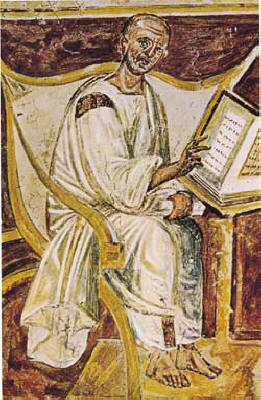
The earliest known portrait of Saint Augustine in a 6th-century fresco, Lateran, Rome
At the start of this book, Augustine had returned home to Thagaste only to be kicked out by his mother for his Manichaen beliefs and less so for his mistress. However, he was able to launch his career as a professor of rhetoric due to his patron, Romanianus, who had provided liberally towards his education. Augustine would stay with him after his mother had kicked him out.
UPDATE: “Confessions”: Book III – Chapters 7 – 12

What do we mean when we say that God is ‘Spirit’? What is a ‘spirit’ anyway? How is it different from a soul? How do we relate with God’s spirit? Or is ‘spirit’ just a fancy way of saying ‘I have no clue what I’m talking about’?
So we had a very active and stimulating meeting last night and discussed a whole range of topics; a lot of it focused on the nature of God and how He relates with us.
Virtually all of us agreed that a theocracy was not the best form of government and disagreed that the Kingdom of God that Jesus talked about would not fall under the category of a theocracy; strains of Manichean beliefs or at least dualism within not only charismatic and fundamentalist sects of Christianity but also Catholicism; struggling to define what a ‘spirit’ actually is and what it means that God is ‘spirit’, and whether or not it differs with the concept of a soul; the eternal question of free will and God’s sovereignty (i.e. Does God have a predetermined plan for everyone’s lives or are we responsible for our own actions) and whether or not the universe might be free and open; and discussions on whether or not God suffers and if that is the case, does that mean He can change his mind or plan on things.
Here are our essays.
“Confessions” – Book III: Chapters 7 – 12

Saints Augustine and Monica, 1854. Artist: Scheffer, Ary (1795-1858)
We will finish the rest of Book III as we go over chapters 7 – 12.
The more questions I think of as I go through Confessions the more profoundly impressed I am of Augustine and his thinking.
Please answer one of these questions and write an essay on it.
 Project Augustine